Brewery effluent is exceptionally high-strength — BOD concentrations commonly ranging from 2,000 to 10,200 mg/L, roughly 10 times stronger than domestic sewage. That organic load translates directly into surcharge bills, compliance risk, and missed sustainability targets.
Anaerobic digestion (AD) has emerged as the most commercially proven answer. It reduces organic load before discharge, generates usable biogas from waste, and gives breweries a credible path toward on-site renewable energy.
This guide covers how AD works in a brewery context, the main system types, the real financial and compliance benefits — and one operational challenge that quietly undermines digester performance over time if left unaddressed.
TL;DR
- Brewery wastewater BOD/COD levels far exceed what municipal systems can absorb without expensive surcharges
- AD breaks down organic waste without oxygen, producing biogas (primarily methane) that offsets real energy costs
- UASB reactors suit high-volume operations, covered lagoons work for moderate-strength waste, and complete-mix digesters handle variable or high-solids feedstocks
- AD alone achieves ~90% BOD removal; combining it with aerobic polishing pushes removal to 98%+
- Sediment buildup reduces active digester volume by 20–30% over time — the biggest long-term threat to system performance
- Bristola's robotic cleaning systems allow brewery digesters to be cleaned and maintained without shutdown or confined space entry
Why Breweries Are Turning to Anaerobic Digestion
The Organic Load Problem
Brewery wastewater is among the strongest industrial effluent in the food and beverage sector. Combined flows without sidestreaming regularly hit BOD of 2,400–10,200 mg/L and COD of 4,000–17,000 mg/L. Individual process streams are even more concentrated — wort COD can reach 400,000 mg/L.
For context, domestic sewage runs 100–500 mg/L BOD. A brewery discharging at 3,000 mg/L BOD is roughly equivalent to 50 homes' worth of organic load in a single industrial outfall.
Municipal treatment plants weren't built for that. They charge accordingly.
Sewer Surcharges and the Sierra Nevada Trigger
Municipalities bill industrial users based on the organic load they discharge. When that load is high enough, surcharges become a significant cost driver — not a rounding error.
Sierra Nevada Brewing in Chico, California experienced this firsthand. A three-fold increase in sewer fees (from approximately $1.80/ccf to over $6.00/ccf) was the direct trigger for installing an on-site UASB anaerobic digester. For a brewery producing 750,000 barrels per year, that fee increase wasn't abstract — it represented a capital investment decision that had a clear payback.
Most large breweries face the same math, just at different volumes.
Regulatory Pressure
Breweries discharging to publicly owned treatment works are classified as industrial users subject to local pretreatment programs under the Clean Water Act. EPA's NPDES permit program sets discharge limits that untreated brewery wastewater routinely exceeds.
For many facilities, on-site pretreatment is legally required, not just financially attractive.
The Sustainability Dimension
Consumer expectations, investor scrutiny, and internal ESG commitments are pushing breweries to convert waste streams into assets rather than liabilities. AD delivers on all three fronts:
- Converts high-strength wastewater into usable biogas
- Reduces carbon emissions tied to sewer discharge and organic waste
- Diverts organic material from municipal treatment systems entirely
Craft breweries not yet generating enough wastewater volume to justify a full AD system have a viable entry point: spent yeast. It's a high-COD, low-volume stream that makes early-stage AD financially workable before scaling up.
How Anaerobic Digestion Works in a Brewery Setting
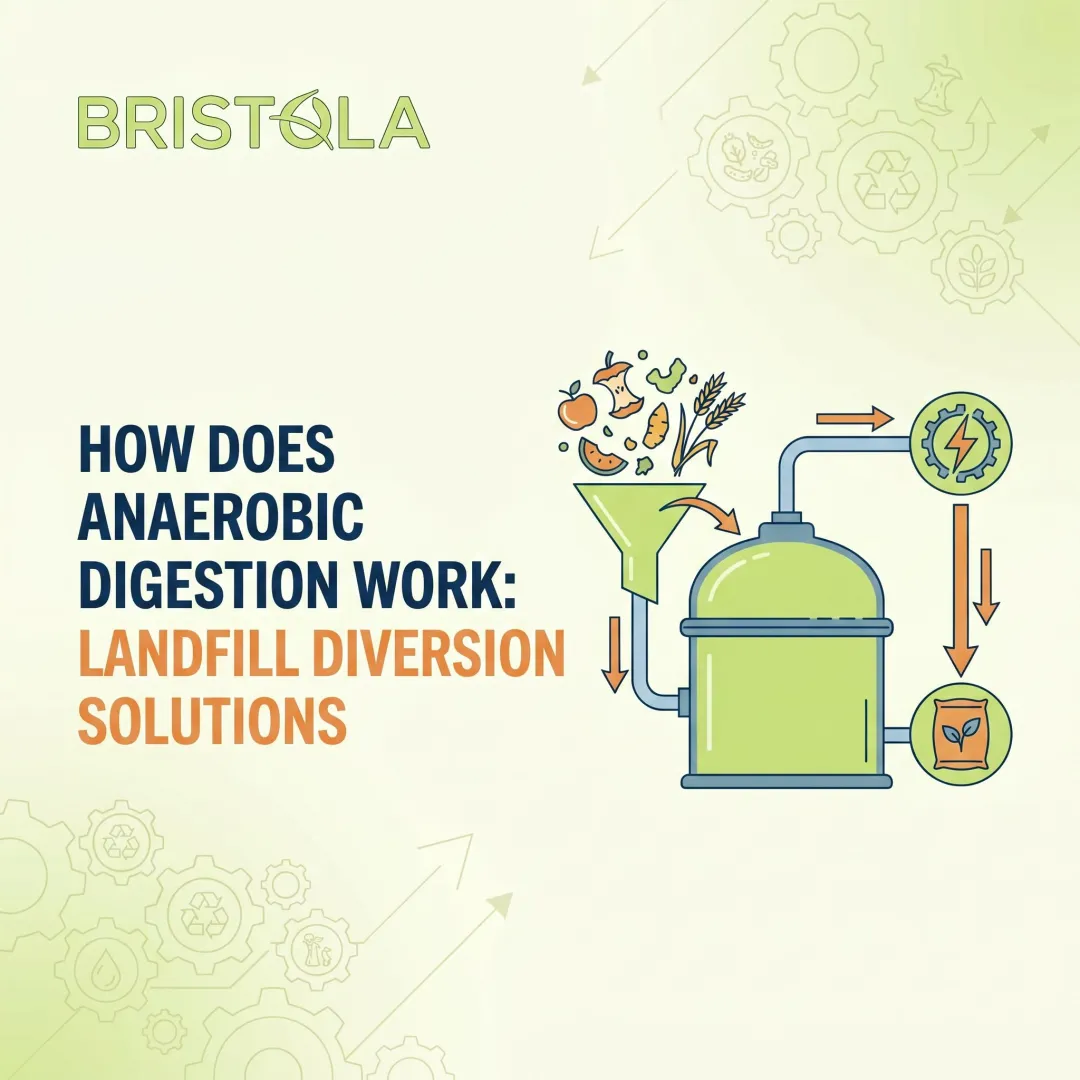
The core principle is straightforward: communities of microorganisms break down organic material in the absence of oxygen. The outputs are biogas (primarily methane and CO₂) and digestate. Brewery wastewater is rich in sugars, starches, yeast, and cleaning residues, making it highly digestible and generates strong biogas yields.
Pretreatment and Equalization
Before wastewater reaches the digester, it goes through several preparation steps:
- Solids screening — removes spent grain, hops, and coarse material
- pH adjustment — brewery effluent is often acidic; anaerobic bacteria need a neutral-to-slightly-alkaline environment to function properly
- Equalization — buffer tanks absorb flow and concentration spikes before they hit the digester
Sudden swings in pH, temperature, or organic loading stress the microbial community and suppress biogas production — stable influent conditions are what keep the process on track.
Inside the Digester
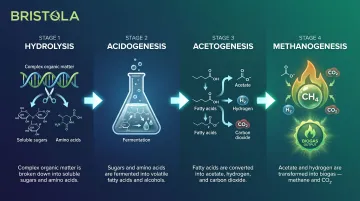
Anaerobic digestion proceeds through four biological stages:
- Hydrolysis — complex organics (starches, proteins, fats) are broken into simpler molecules
- Acidogenesis — bacteria convert those molecules to volatile fatty acids and alcohols
- Acetogenesis — fatty acids are converted to acetate, hydrogen, and CO₂
- Methanogenesis — methanogens convert acetate and hydrogen to methane
Most brewery digesters run mesophilically (30–40°C), which offers greater process stability and tolerance for temperature fluctuations. Thermophilic operation (50–60°C) shortens retention times and improves pathogen destruction, but it demands tighter process control.
Biogas Capture and Utilization
Raw biogas exiting the digester contains methane, CO₂, hydrogen sulfide, and water vapor. Before use, it needs conditioning: H₂S removal and dehumidification at minimum.
The main utilization pathways:
- Boiler combustion for direct heat
- Combined heat and power (CHP) for on-site electricity and thermal energy
- Renewable natural gas (RNG) upgrading for pipeline injection or vehicle fuel
Sierra Nevada's Chico facility demonstrates what's achievable: biogas from their UASB digester powers four 300-kW fuel cells. Combined with 1.9 MW of solar, the brewery generates 80–85% of its annual electricity on-site.
Post-Digestion Treatment
Maximizing energy recovery is only part of the equation — effluent quality still has to meet permit limits before discharge. AD alone achieves roughly 90% BOD removal, which falls short of most regulatory thresholds. A downstream aerobic treatment step (activated sludge, membrane bioreactor, or sequencing batch reactor) brings removal to 98% COD, 98% BOD, and 99% TSS. For breweries operating under strict discharge permits, pairing anaerobic and aerobic treatment is the accepted design approach.
Types of Anaerobic Digestion Systems Used in Breweries
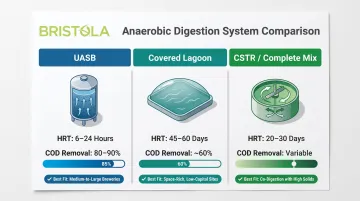
| Technology | HRT | COD Removal | Best Fit |
|---|---|---|---|
| UASB | 6–24 hours | 80–90% | Medium-to-large breweries, high soluble organic loads |
| Covered Lagoon | 45–60 days | ~60% | Space-rich sites, lower capital budgets |
| CSTR (Complete Mix) | 20–30 days | Variable | Co-digestion with spent grain, yeast, higher solids |
UASB (Upflow Anaerobic Sludge Blanket) is the dominant technology in brewery applications. Wastewater flows upward through a dense blanket of granular biomass, achieving rapid COD reduction in a compact footprint with hydraulic retention times as short as 6 hours. Sierra Nevada's Chico facility demonstrates what's achievable: influent COD of 4,200 mg/L reduced to roughly 400 mg/L — a 90% reduction in a single pass.
Covered lagoons offer lower construction costs but require considerably more land and deliver lower removal efficiency. The appeal is simplicity and low capital cost. The tradeoff is land area and inconsistent performance across seasons. Sludge can accumulate for up to 20 years before requiring removal, at which point facilities face a large-scale cleanout that can disrupt operations for weeks if not planned in advance.
Complete-mix digesters (CSTRs) handle variable feedstocks and higher suspended solids better than UASB systems. They're the practical choice for breweries co-digesting wastewater with spent grain or yeast slurry, where the feedstock mix changes over time.
Each system type carries distinct maintenance requirements — particularly around sediment accumulation and cleaning access — which directly affects long-term performance and biogas yield.
Benefits Beyond Wastewater Treatment
Financial Returns
A well-designed AD system generates savings across multiple line items:
- Reduced sewer discharge fees — lower BOD/COD load means lower surcharges
- Energy offset — Sierra Nevada's system offsets 10–15% of total energy costs from biogas alone; Austria's Gösser Brewery covers 100% of its thermal energy needs from biogas, earning it recognition as the world's first major carbon-neutral brewery
- Reduced sludge hauling — digestate requires less frequent disposal than raw sludge
- Government incentives — the IRA Investment Tax Credit provides up to 30% credit for qualified biogas property; USDA REAP grants cover up to 25% of project costs
Capital costs range from approximately $1.5M for a medium brewery digester to $5M+ for large UASB systems treating 500,000 gpd. Breweries combining incentives, sewer fee savings, and energy offsets typically see payback in 3–8 years.
Compliance and Liability Reduction
On-site AD pretreatment reduces the BOD/COD load sent to the municipal plant, lowering the risk of permit violations, fines, or operational restrictions. For breweries in municipalities with active industrial pretreatment enforcement, this protection has real dollar value — one that shows up directly in avoided fines and reduced surcharge exposure.
Sustainability Credentials
Generating on-site renewable energy from a waste stream, reducing carbon emissions, and diverting organic waste from the sewer system supports ESG goals in concrete, measurable terms. For breweries responding to consumer expectations and investor scrutiny, a functioning AD system provides documented, auditable results — not just policy language or pledges.
The Hidden Challenge: Maintaining Your Brewery Digester for Peak Performance
How Sediment Accumulation Erodes System Performance
AD systems don't degrade dramatically overnight. They erode gradually, and that's precisely what makes sediment accumulation so easy to overlook until real damage has already occurred.
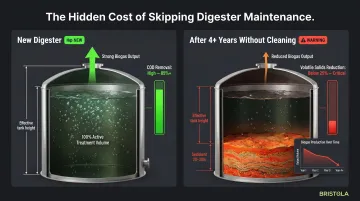
Over time, non-digestible solids accumulate at the bottom and walls of the digester. In brewery applications, this includes inorganic grit, hop particles, grain fines, and thickened sludge that the biological process can't fully break down. This buildup:
- Progressively reduces the tank's active treatment volume
- Shortens hydraulic retention time, reducing contact between waste and microorganisms
- Diminishes biogas yield and COD removal efficiency
- Stresses the microbial community by disrupting stable operating conditions
Research documents that sludge and grit accumulation can reduce active digester volume by 20–30% over time. In one documented case, a digester that hadn't been cleaned in over four years saw volatile solids reduction drop below 25% and daily biogas production fall by 20%. The AD system was still running — but it was delivering a fraction of its designed output and eroding the return on every dollar invested in it.
The Traditional Fix — and Its Costs
The conventional response to sediment buildup is a full shutdown: drain the digester, pump out the contents, and send workers inside to manually clean the tank. The consequences are significant:
- Weeks of production loss and temporary storage requirements
- Cleaning costs of $20,000 to $110,000+ per event, depending on tank size and accumulated material
- Confined space entry hazards — toxic gases, oxygen-depleted atmospheres, and structural risks
That last point deserves emphasis. According to the U.S. Bureau of Labor Statistics, 1,030 workers died from injuries involving confined spaces between 2011 and 2018, with 435 of those fatalities caused by atmospheric hazards alone. OSHA's 29 CFR 1910.146 standard governs confined space entry for exactly this reason — the risk is well-documented and legally regulated.
Every manual digester cleanout is a confined space entry event. The safety exposure isn't theoretical.
The Modern Alternative: Robotic Cleaning Without Shutdown
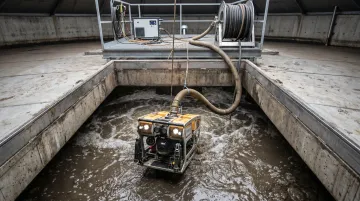
Both problems — the financial cost and the safety exposure — have a direct solution. Bristola's zero-human-entry robotic cleaning system was built specifically to address them. Founded in 2019 by Jared Burma, whose near-death experience inside a tank drove him to develop a safer alternative, Bristola uses a patented airlock-type equalization chamber entry system to deploy a submersible ROV into active digesters and covered lagoons without draining the tank or halting operations.
The system works through a one-of-a-kind entry portal that can be adapted to any manhole 24 inches or larger. The ROV enters on a winch, cleans the tank floor, and removes sediment through a flexible hose to a processing option of the operator's choice. The facility keeps running throughout — no shutdown, no confined space entry, and no lost biogas production during the cleaning window.
Bristola's system can be retrofitted to existing brewery digester infrastructure. After an initial installation — which includes a baseline clean and entry portal placement — future cleaning cycles require no draining and no human entry into the tank.
The full-service system also evaluates, stores, and reports data on facility condition and performance. Operators get ongoing visibility into sediment accumulation rates and tank health, rather than discovering problems only when performance has already declined.
For brewery digesters specifically, where organic loading varies seasonally and hop compounds introduce atypical solids, scheduled robotic cleaning is the practical path to protecting both biogas output and system longevity over the full life of the asset.
Frequently Asked Questions
How much does an anaerobic digestion system cost for a brewery?
Capital costs range from approximately $1.5M for a mid-sized brewery UASB digester to $5M+ for large systems treating 500,000 gpd. Payback periods of 3–8 years are achievable at scale through sewer fee savings and energy offsets. The IRA Investment Tax Credit (up to 30%) stacked with USDA REAP grants (up to 25%) can offset up to 55% of eligible capital costs.
What size brewery benefits most from anaerobic digestion?
Large-volume breweries (roughly 500,000+ barrels per year) see the strongest economics, with payback periods in the 3–8 year range. Craft breweries face longer payback windows — 14–19 years in some analyses — but can improve viability by starting with high-strength side streams like spent yeast and scaling up over time.
How does anaerobic digestion compare to aerobic treatment for breweries?
AD produces energy as a byproduct and carries lower operating costs, but requires higher capital investment. Aerobic treatment is cheaper to build but more expensive to operate due to continuous aeration energy demands. The two approaches are most often combined: AD as the primary treatment stage, aerobic polishing to meet final discharge standards.
How is biogas from a brewery digester typically used?
The main pathways are direct combustion in boilers for heat, combined heat and power (CHP) for on-site electricity, and upgrading to renewable natural gas (RNG) for pipeline injection or vehicle fuel. Large breweries with CHP or microturbine installations can cover a substantial share of total energy needs from biogas alone.
How often does a brewery anaerobic digester need to be cleaned?
General guidance for well-managed industrial digesters points to cleaning every few years, though food waste digesters with higher solids loading may require annual attention. The key is shifting from reactive to proactive maintenance. Bristola's robotic system runs continuous or scheduled cleaning cycles without shutdown — sustaining performance instead of recovering from degradation after it's already occurred.