Introduction
Every year, workers enter liquid storage tanks, digesters, and waste lagoons to do what should be routine maintenance. Some don't come back. Between 2011 and 2018, 1,030 workers died from occupational injuries involving confined spaces, with tanks, bins, and vats accounting for 205 of those deaths — the single largest category.
The financial cost compounds the problem. Extended shutdowns, temporary storage logistics, regulatory penalties, and liability exposure make conventional tank cleaning one of the most expensive recurring operations in heavy industry.
Robotic commercial cleaning solutions have moved well past the experimental stage. Bristola, for example, deploys zero-human-entry systems that clean active liquid storage facilities — digesters, lagoons, refinery tanks, wastewater vessels — while they remain fully operational, with no confined space entry and no exposure to the hydrogen sulfide or hydrocarbon vapors that have killed workers for decades.
This article identifies the industries where robotic cleaning delivers the greatest operational, safety, and financial return — and what separates strong candidates from poor fits.
TL;DR
- Six industries — oil & gas, biogas/RNG, wastewater treatment, food & beverage, pulp & paper, and protein processing — have the most to gain from robotic tank cleaning
- All six sectors share hazardous confined spaces, mandatory cleaning schedules, and high costs tied to downtime
- Zero-human-entry systems clean tanks while production continues, eliminating the safety risk and the revenue loss at the same time
- Over 61% of permit-required confined space fatalities occur during cleaning or maintenance activities
- The right system should operate in active tanks, require no confined space entry, and retrofit to existing infrastructure
What Makes an Industry a Strong Fit for Robotic Commercial Cleaning?
Three conditions consistently signal that an industry is a prime candidate for robotic cleaning:
- Mandatory, recurring cleaning cycles tied to regulatory compliance or process efficiency — not optional maintenance that can be deferred indefinitely
- Hazardous environments where manual cleaning creates serious safety liability, including toxic or flammable atmospheres classified under OSHA's permit-required confined space standard (29 CFR 1910.146)
- High operational cost attached to shutting down production for cleaning — whether measured in lost output, temporary storage, or restart delays
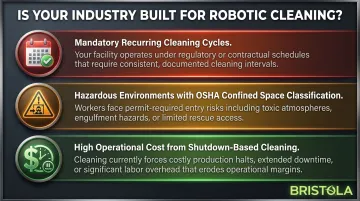
Industries operating large liquid storage tanks, anaerobic systems, or process vessels check all three boxes. Sludge and sediment accumulation in these environments isn't just a housekeeping issue. It directly degrades output: active tank volume shrinks, biological processes slow, and measurable revenue walks out the door.
The Regulatory Layer
OSHA's 29 CFR 1910.146 standard requires written permit programs, atmospheric testing, outside attendants, and rescue provisions for any permit-required confined space entry. Non-compliance carries penalties up to $16,550 per serious violation and $165,514 per willful or repeat violation as of 2025 adjustments.
OSHA isn't the only framework in play. Each sector covered below answers to its own set of mandates:
- EPA 40 CFR Part 503 governs sewage sludge management at wastewater facilities
- FSIS standards set sanitation requirements for food and protein processing operations
- API 653 mandates internal inspections for aboveground petroleum storage tanks
Across every one of these sectors, tank cleaning is non-negotiable. The consequences of non-compliance range from permit revocations and production shutdowns to regulatory fines that dwarf the cost of the cleaning itself.
Industries Best Suited for Robotic Commercial Cleaning Solutions
The six industries below were selected based on confined space hazard severity, cleaning frequency and criticality, and operational loss tied to scheduled downtime.
Oil & Gas and Petroleum Refining
Crude oil storage tanks, refinery vessels, and fuel transport tanks accumulate hydrocarbon sludge, scale, and residue that must be periodically removed to maintain tank integrity, regulatory compliance under API 653, and accurate volumetric measurement.
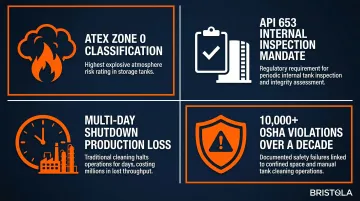
The environment is the problem. Tank interiors in active petroleum operations are typically classified as ATEX Zone 0 — meaning an explosive atmosphere is present continuously or for extended periods under normal operating conditions.
Manual cleaning in these environments requires full tank evacuation, extended ventilation, atmospheric monitoring, and multiple personnel in confined spaces wearing supplied air. Between 2018 and 2022, the oil and gas industry recorded 383 fatalities across all causes — and OSHA issued nearly $1.6 million in penalties to oil and gas companies in 2023 alone.
Robotic systems eliminate the need to evacuate and ventilate before human entry. The cleaning window compresses from a multi-day shutdown into an active-tank operation. Bristola's system — deployed by clients including Shell — uses a patented equalization chamber entry mechanism that works through any 24-inch or larger manhole, adapting to existing tank infrastructure without new construction.
Key drivers in oil and gas:
- ATEX Zone 0 classification makes human entry a high-liability operation
- API 653 mandates internal inspections tied to cleaning
- Multi-day conventional cleaning windows create significant production loss
- 10,000+ OSHA violations cited in the sector over the past decade
Biogas and Renewable Natural Gas (Anaerobic Digesters)
Anaerobic digesters accumulate fibrous solids, grit, and inorganic sludge over time. As that material builds, active digester volume shrinks and gas output drops. One documented case showed a customer's volatile solids reduction falling below 25% and daily biogas production yield declining by 20% before intervention.
Conventional cleaning means draining the digester, removing solids manually, and waiting for biological processes to restart — a sequence that can mean weeks of lost gas production.
For operators in the renewable natural gas market, projected to grow from $13.13 billion in 2023 to $34.47 billion by 2033, that downtime translates directly to lost revenue at the worst possible time.
Bristola's patented equalization chamber entry system enters through the tank roof while the digester remains in active operation, removing accumulated solids without any human entry or shutdown. Clients including Brightmark, Vanguard Renewables, and Maas Energy Works operate digesters maintained through this approach.
Wastewater and Water Treatment
There are 17,544 publicly owned treatment works in the United States alone, processing approximately 34 billion gallons of wastewater daily. Every one of them operates holding tanks, clarifiers, and equalization basins that require periodic desludging to maintain treatment efficiency and permit compliance under EPA 40 CFR Part 503.
The hazard profile is severe. Hydrogen sulfide — present in sewers, wet wells, and digesters — caused 46 worker deaths between 2011 and 2017.
H2S is heavier than air, accumulates in low-lying spaces, and deadens the sense of smell before reaching lethal concentrations. OSHA's immediately dangerous to life or health (IDLH) threshold is just 100 ppm.
Robotic cleaning removes the confined space entry hazard entirely. Bristola has deployed systems at municipal wastewater facilities including Sioux City's treatment plant, enabling cleaning during lower-flow periods without full operational shutdown.
Food and Beverage Processing
Food processing facilities run fermentation tanks, mixing vessels, silos, and ingredient storage tanks on strict cleaning schedules tied to FDA, USDA, and HACCP standards. Contamination events carry severe consequences: the average direct cost of a food recall is $10 million, and that figure doesn't include brand damage, litigation, or lost shelf placement.
Manual tank cleaning in these environments means production halts, labor-intensive entry procedures, and extended sanitization cycles. Robotic systems enable faster, more consistent cleaning with less production interruption — and the ROV doesn't introduce contamination risk the way human workers can.
Bristola serves food and beverage processors including ADM and Gevo, cleaning fermentation and storage vessels while protecting hygiene compliance and reducing the downtime associated with traditional cleaning cycles.
Pulp, Paper, and Heavy Manufacturing
Pulp mills and chemical processing plants rely on black liquor vessels, chemical storage tanks, and process tanks where deposits affect flow rates, heat transfer efficiency, and yield. The American Forest & Paper Association recommends annual or biennial safety audits of recovery boiler systems, all of which require clean, inspectable vessels.
The real barrier is cost and disruption. Conventional cleaning is expensive enough that facilities routinely delay maintenance, letting efficiency losses compound between cycles.
Bristola completed a covered lagoon deployment at a pulp and paper production facility to remove accumulated solids affecting COD and BOD treatment — without operational downtime. Maintaining cleaner tanks on a more frequent schedule, without extended planned shutdowns, translates directly to more consistent process performance and longer asset life.
Slaughterhouse and Protein Processing
Slaughterhouse operations use covered digesters, waste lagoons, and liquid waste storage tanks that accumulate organic solids from processing operations. These are among the most dangerous confined space environments in any industry.
Between 1975 and 2024, 301 people died out of 491 involved in livestock waste-related confined space incidents — a 61% fatality rate. The primary lethal agent is hydrogen sulfide, which decomposing organic matter generates at concentrations that can be fatal within seconds of exposure. When someone is overcome, survival is statistically unlikely.
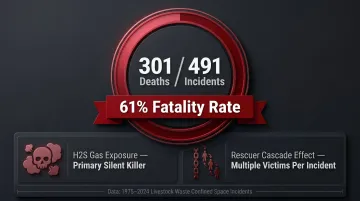
Robotic systems replace a process that has historically resulted in fatalities with a remote-operated, sensor-equipped machine that performs the same work with no human exposure. Bristola serves protein processing clients including JBS, deploying its zero-human-entry system in covered lagoons and anaerobic storage vessels that would otherwise require dangerous confined space entry.
The Hidden Costs of Not Automating
The direct cost of conventional tank cleaning — labor, equipment rental, shutdown coordination, temporary waste storage — is visible and budgeted. The indirect costs are harder to quantify but often larger.
What facilities consistently undercount:
- Lost production output during each shutdown window
- Insurance and liability exposure from confined space entry events
- Cumulative efficiency loss between cleaning cycles when maintenance is deferred
- OSHA penalty exposure from violations during cleaning operations
- The total cost of a fatality, which the National Safety Council estimates at $1,540,000 per workplace death — before litigation
A single willful OSHA violation now carries a maximum penalty of $165,514. The oil and gas sector accumulated $1.6 million in OSHA penalties in 2023 alone, spread across hundreds of citations. For facility managers, that's not a worst-case scenario — it's an industry pattern.
Penalty exposure is one side of the ledger. Efficiency loss is the other, and it hits hardest in biogas, RNG, and wastewater applications. Sludge accumulation reduces useful tank volume and process output. A facility running with partially functional tanks loses revenue every day it defers cleaning. It also builds toward a more disruptive and expensive eventual shutdown.
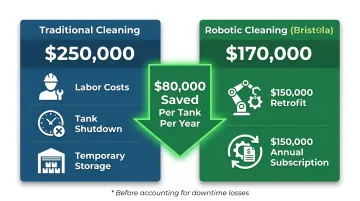
One Bristola case study illustrates the math clearly: annualized cost using traditional cleaning methods ran $250,000 per tank. With Bristola's system, including the initial $150,000 retrofit and $150,000 annual subscription, the annualized cost drops to $170,000. That's $80,000 in savings per tank per year, before accounting for eliminated downtime losses.
What to Look for in a Robotic Cleaning Solution for Industrial Use
The most common mistake when evaluating robotic cleaning systems is selecting based on general automation capability rather than fit for the specific environment. A system that works well in a food processing tank may not be engineered for the pressurized, gas-rich conditions inside an active anaerobic digester.
Critical questions to ask any vendor:
- Can the system enter and operate in an active, liquid-filled tank without requiring shutdown?
- Does it require any confined space entry at all — by anyone?
- Can it retrofit to existing tank infrastructure, or does it require new construction?
- What is the entry mechanism, and how does it handle pressurized or gas-present environments?
- Does the vendor have documented deployments in your specific environment type?
Technical Capabilities That Matter
For hazardous industrial environments, the core requirements are:
- Zero-human-entry operation: no personnel in the tank at any stage — critical for OSHA compliance and production continuity
- Proven entry mechanism: a patented or independently validated system for accessing active tanks without depressurizing or draining
- Remote operation capability with onboard data collection on tank condition and cleaning performance
- Retrofit compatibility: works with existing infrastructure, no tank replacement or major structural modification required
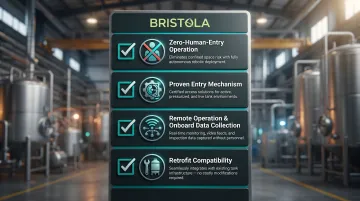
Meeting these technical thresholds narrows the field quickly. What separates the remaining options is proven performance in environments like yours.
Proven Track Record in Your Sector
Ask vendors for reference clients in your specific industry — not general industrial experience. A robotic system that has cleaned municipal wastewater clarifiers is a different qualification than one that has cleaned crude oil storage tanks or protein processing lagoons. Bristola has active clients across anaerobic digestion, covered lagoons, petroleum storage, wastewater treatment, food processing, and pulp and paper — including JBS, Shell, Brightmark, and ADM, among others.
Conclusion
The industries best suited for robotic commercial cleaning share a common problem: sending workers into hazardous confined spaces to clean liquid storage vessels carries regulatory, financial, and human costs that are getting harder to absorb — and harder to defend.
Zero-human-entry robotic cleaning eliminates the safety risk at the source rather than layering more protection around a dangerous activity. Facilities that make the switch clean tanks more safely and keep equipment running without building maintenance windows into their production schedule.
If your facility operates in oil and gas, biogas, wastewater treatment, food and beverage processing, pulp and paper, or protein processing — and conventional cleaning still means shutdowns, confined space entry, or both — explore Bristola's zero-human-entry robotic tank cleaning system. Bristola's system cleans liquid storage facilities with no human entry and no production downtime — while the tank stays fully operational.
Frequently Asked Questions
What industries are most suitable for robotic commercial cleaning?
Oil and gas, biogas/RNG, wastewater treatment, food and beverage, pulp and paper, and protein/slaughterhouse processing are the strongest candidates. These sectors share hazardous confined spaces, mandatory cleaning schedules, and significant operational costs tied to conventional shutdown-based maintenance.
What are the trends and outlook for robotic commercial cleaning?
The industrial tank cleaning robot market is projected to grow at a 12.7% CAGR through 2033, driven by tightening OSHA and EPA enforcement and rising penalty thresholds. That growth reflects a broader shift away from scheduled maintenance shutdowns toward continuous-operation robotic systems that eliminate both safety risk and downtime.
Can robotic cleaning systems operate while a tank or liquid storage facility is still in use?
Advanced systems — including those using patented equalization chamber or airlock-type entry mechanisms — are specifically engineered for active-tank operation. Bristola's system enters through existing manholes and cleans while the facility remains in full production, eliminating the need to drain or shut down the vessel.
What are the safety benefits of robotic cleaning in hazardous industrial environments?
Robotic systems eliminate confined space entry entirely, removing worker exposure to hydrogen sulfide, hydrocarbon vapors, methane, and other IDLH atmospheres. This directly addresses OSHA 29 CFR 1910.146 requirements and eliminates both primary injury risk and the rescuer cascade effect — where untrained bystanders attempt rescue and become victims themselves — which accounts for roughly 60% of confined space fatalities.
What industry does commercial cleaning fall under?
Janitorial and facility cleaning falls under building services and facility management. Industrial tank and vessel cleaning — including robotic systems — falls under industrial maintenance, environmental services, and asset management. They are distinct sectors with different regulatory frameworks, hazard profiles, and technology requirements.
How much do robotic industrial cleaning systems typically cost?
Pricing varies by tank size, access configuration, and deployment type. A more useful measure is total cost of ownership. One documented Bristola deployment reduced annualized cleaning costs from $250,000 to $170,000 per tank — an $80,000 annual saving — after accounting for the initial retrofit and ongoing service subscription.