The variables that drive costs — scale, feedstock type, digester technology, and whether you're upgrading to pipeline-quality RNG — matter more than any single benchmark figure. Get those wrong in the planning phase and you'll either overbuild an expensive system that never pays back, or underbuild one that can't handle your actual waste volume.
This guide covers cost tiers by scale, the major cost components, a practical step-by-step installation overview, and what to expect in ongoing operational expenses — so you can build a realistic budget before committing.
TL;DR
- Residential biogas systems cost $1,500–$15,000; commercial and agricultural systems range from $400,000 to $5 million; industrial RNG plants can exceed $39 million
- The digester vessel typically represents 35–40% of total installed cost; gas upgrading and civil works each contribute another 15–25%, with permitting and site prep rounding out the budget
- Annual operating costs run approximately 2–3% of capital cost, and well-planned projects achieve payback in 2–7 years (residential) or 4–10 years (commercial/industrial)
- At commercial scale, multiple revenue streams — RNG sales, federal RINs credits, LCFS credits, and digestate sales — are what make the numbers work
Biogas Plant Cost by Scale: Residential to Industrial
Scale is the single biggest variable in biogas economics. Per-unit costs fall sharply as capacity increases, which is why a mid-scale farm digester costs far less per cubic meter of gas produced than a residential unit — despite the much larger total price tag.
Residential and Small-Scale Systems
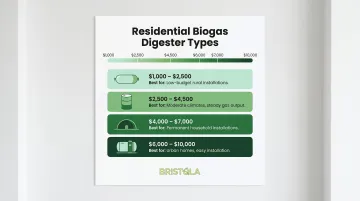
Small home digesters serving 1–5 people or a compact livestock operation typically fall in the $1,500–$15,000 range, depending on technology type:
| Digester Type | Cost Range | Best For |
|---|---|---|
| Balloon/tubular | $1,000–$3,000 | Lowest-cost entry point |
| Floating drum | $2,000–$6,000 | Mid-range residential |
| Fixed dome | $3,000–$8,000 | Durability, long lifespan |
| Prefabricated unit | $3,500–$10,000 | Ease of installation |
A household generating 1–2 kg of food waste daily can support roughly 1–3 hours of cooking gas per day. According to current benchmarks, residential systems can reduce household energy costs by 20–60%, potentially saving over $1,000 annually for households spending around $150/month on fuel. Payback periods typically land in the 2–7 year range.
Commercial and Agricultural Systems
Beyond residential scale, mid-scale systems serving farms, food processors, and small municipalities carry higher price tags — but they also unlock more revenue streams that residential units can't access.
The U.S. EPA AgSTAR program reports on-farm anaerobic digester capital costs ranging from $400,000 to $5 million, with a typical system around $1.2 million. Penn State Extension models a 675-cow dairy digester at $1.3 million CapEx, including generation equipment and solids separators. Installed electrical capacity runs roughly $500–$1,500 per kW.
Co-digestion (combining manure with food waste or other organic streams) is one of the most powerful financial levers at this scale. Penn State's analysis found that adding food waste to a manure-based system can:
- Boost total project value to over $3.2 million
- Cut payback from 10.2 years down to 1.3 years with high tipping fees and grant support
- Open access to tipping fee revenue that manure-only systems can't generate
Industrial and RNG-Scale Plants
Large industrial projects processing municipal solid waste, food industry effluent, or mixed agricultural residues operate at a scale where capital costs reach into the tens of millions — and regulatory credit revenues become essential to the business case.
ERM/MJB&A benchmarks a mid-to-large landfill RNG project at $21.5 million and a dairy RNG facility (2,000 cows) at $6–8 million. Full-scale RNG production facilities with gas upgrading and biofertilizer processing equipment can reach $39 million or more in total capital expenditure.
Industrial projects depend heavily on regulatory credit revenues to achieve financial viability:
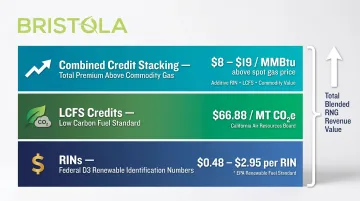
- RINs (Renewable Identification Numbers): Federal credits earned under the Renewable Fuel Standard. D3 RINs have historically traded between $0.48 and $2.95, with the California Energy Commission valuing RIN revenue at $3.36–$14.45 per MMBtu
- LCFS credits (Low Carbon Fuel Standard): California-specific credits averaging $66.88 per metric ton CO₂e (CARB, May 2026). Manure-based RNG achieves carbon intensity scores averaging -313 g CO₂e/MJ, maximizing LCFS value
- Combined, credit stacking can add $8–$19/MMBtu in revenue above commodity gas price
What Drives Biogas Plant Costs: Key Components
Regardless of scale, biogas plant costs break down into the same fundamental categories. Understanding each one helps operators make smarter decisions during design and procurement.
The Digester Vessel
The anaerobic digester is typically the largest single cost component, representing 35–40% of total installed cost. Technology choice, materials, and operating conditions all affect total cost significantly.
Concrete vs. steel — a quick comparison:
| Attribute | Concrete | Steel (Glass/Epoxy-Coated) |
|---|---|---|
| Lifespan | 100+ years | 10-year warranty; coating-dependent |
| Insulation | Superior inherent insulation | Requires external insulation |
| Corrosion resistance | Inherent | Rapid risk if coating is breached |
| Construction speed | Precast panels cut time by ~50% | Light steel systems cut time by 50–75% |
Digester type also affects cost significantly:
- CSTR (Continuously Stirred Tank Reactor): Most flexible for co-digestion, but higher upfront cost
- Plug-flow reactors: Often lower initial investment and simpler startup
- UASB and two-stage systems: Higher capital cost, but better suited for complex or high-strength feedstocks
- Fixed dome (residential): Locally built units run $4,000–$5,000 for small-scale installations
Gas Conditioning and Upgrading
For RNG projects, gas upgrading is the second-largest cost driver — accounting for 37% of total dairy RNG project cost. Equipment costs for a 1,000 Nm³/h capacity system range from roughly €1.2 million (water scrubbing) to €2.5 million (cryogenic separation) per European industry benchmarks. Membrane separation captures 64% of the market for manure-based RNG facilities at an investment of approximately €1.5 million, with annual maintenance running about 2–2.4% of that figure.
Total upgrading cost to pipeline-quality RNG ranges from $7 to $25 per MMBtu depending on scale. Costs fall steeply as capacity increases, making larger projects significantly more economical per unit of output.
Civil Works, Pre-Treatment, and Permitting
Beyond the digester and gas train, three cost buckets catch operators off guard:
- Feedstock pre-treatment: Food waste requires depackaging, maceration, and contaminant screening. Agricultural manure typically needs only minimal processing. The complexity gap translates directly to capital cost.
- Civil and site costs: Land acquisition, foundations, buildings, access roads, and SCADA/automation systems collectively form the "balance of plant" bucket — 37% of total dairy RNG project cost per ERM benchmarks.
- Pipeline interconnection: In California, interconnection averages $1.5–$3 million per site, representing approximately 21% of total dairy RNG project cost. For projects in other states, costs are primarily distance-dependent.
- Permitting: Environmental review, air quality permits, and waste handling licenses add 90–180 days (or more) to project timelines for mid-scale facilities. For complex projects requiring full environmental impact assessments, permitting can stretch well beyond a year.
Biogas Plant Installation: A Step-by-Step Overview
The planning phase determines whether a biogas project succeeds or fails. Cutting corners early creates expensive problems during construction and commissioning.
Step 1: Conduct a Feedstock and Feasibility Assessment
Start with a waste audit — track feedstock type, volume, and consistency over at least two weeks before sizing anything. System size should always follow feedstock availability, not energy goals.
Key yield benchmarks to inform sizing:
| Feedstock | Biogas Yield (per kg volatile solids) | Methane Content |
|---|---|---|
| Food waste | 400–800 liters | 50–70% |
| Dairy cow manure | 200–300 liters | 55–60% |
| Pig manure | 300–400 liters | 60–70% |
| Poultry manure | 450+ liters | 60–65% |
Fat-rich feedstocks (restaurant grease, for example) hit the upper end of yield ranges due to high lipid energy content. A single dairy cow can generate 1.5–2.5 cubic meters of biogas per day.
Step 2: Select Digester Technology and System Design
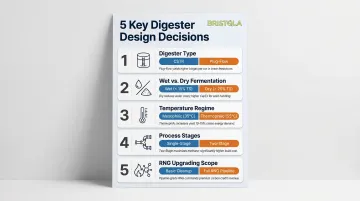
Key design decisions — each with real cost and yield implications:
- Digester type — CSTR for feedstock flexibility; plug-flow for lower upfront cost
- Wet vs. dry fermentation — wet systems (under 15% total solids) are more common; dry systems handle fibrous feedstocks better
- Temperature regime — mesophilic (95–104°F) costs less to heat; thermophilic (131–140°F) yields more gas but requires more energy input
- Single-stage vs. two-stage — two-stage improves stability with complex feedstocks but adds capital cost
- RNG upgrading scope — the biggest single decision affecting both CapEx and revenue potential
Engage a qualified design engineer before committing to equipment or vendor quotes.
Step 3: Secure Permits and Site Approvals
Typical US biogas permitting requirements include:
- Zoning and land use approval
- Environmental review (NEPA or state equivalent)
- Air quality permits
- Solid or liquid waste handling permits
- Utility interconnection agreements (for RNG injection or grid-connected power)
Permitting timelines range from several months to over a year depending on project scale and jurisdiction. Factor this into financing timelines: most lenders require permit approval before releasing construction funds, so delays here directly push back your first dollar of revenue.
Step 4: Construction, Equipment Installation, and Commissioning
The typical construction sequence:
- Site preparation and foundation work
- Digester vessel construction or installation
- Gas system installation (collection, conditioning, upgrading)
- Electrical, controls, and SCADA integration
- Utility interconnection
Mid-scale facilities typically take 4–6 months to build once permits are secured. Large RNG projects with pipeline interconnection should budget 12–18+ months from groundbreaking to commissioning. Unique site characteristics — pipeline distance, soil conditions, custom engineering — make cost overruns a genuine risk. Get binding vendor quotes and vet contractors on biogas-specific project experience before signing anything.
Step 5: Startup, Inoculation, and Ramp-Up
Digesters must be inoculated with active microbial culture (typically sourced from an operating facility) and ramped up gradually over several weeks. Gas quality and yield will run below design targets throughout this period.
Build the ramp-up phase into your first-year financial model. Key planning points:
- Inoculation source: Secure a culture source from an operating facility before commissioning begins
- Ramp-up window: Budget 4–8 weeks to reach stable, near-design output
- Revenue modeling: Use 60–70% of design capacity for year-one projections to avoid cash flow shortfalls
Ongoing Operating Costs Every Operator Should Budget For
OPEX is just as important as CapEx in long-term biogas economics, and many operators underestimate it. Energypedia benchmarks annual operation and maintenance costs at 2–3% of total investment. Penn State Extension reports approximately $15,000 per year for a mid-scale dairy digester covering routine maintenance, sludge cleanout, and engine rebuilds every 2.5 years.
Main OPEX line items:
- Feedstock acquisition or tipping fees (which can become revenue for waste-accepting facilities)
- In-plant electricity and heat consumption — digester heating alone consumes 10–20% of total energy output
- Chemical inputs: desulfurizing agents, pH adjusters, flocculants
- Operator labor and management
- Annual maintenance: mixing systems, gas system inspections, pump and valve upkeep, heat exchanger service, and engine overhauls
Digester Cleaning: The OPEX Line Item Operators Underestimate Most
Sludge and sediment accumulate in anaerobic digesters over time, progressively reducing active volume and hydraulic retention time. When left unaddressed, the problem compounds fast.
One documented case involving a 1.2-million-gallon EnviTec digester in New York showed that after four years without cleaning, daily biogas production yield had dropped by 20%, volatile solids reduction fell below 25%, and the facility struggled to maintain mesophilic operating temperature in winter.
Traditional cleaning requires draining the tank and taking it fully offline. Based on Bristola's case study data, the annualized cost of traditional cleaning — including $300,000 in direct cleaning costs, $200,000 in revenue loss during downtime, plus chemical treatment and logistical expenses — totals approximately $250,000 per tank per year.
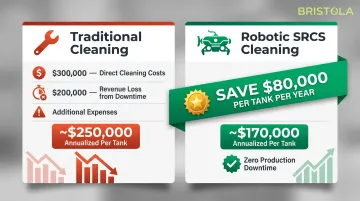
Bristola's Submersible Robotic Cleaning System (SRCS) eliminates that tradeoff. The patented equalization chamber entry system allows a remote-controlled submersible ROV to enter and clean the digester through any standard manhole (24 inches or larger) while the facility remains fully operational: no human entry, no production downtime.
Based on the same case study, the annualized cost using the SRCS with an annual subscription comes to approximately $170,000 — delivering $80,000 in savings per tank per year compared to conventional methods. The system is available for both new-build installations and retrofits on existing digesters.
How to Maximize ROI on Your Biogas Plant
Financial viability comes from controlling costs and maximizing revenue simultaneously. The highest-impact actions:
On the cost side:
- Optimize feedstock mix through co-digestion to increase gas yield without proportional cost increases
- Implement smart process controls to reduce parasitic energy consumption
- Maintain clean digesters consistently — sediment-related output loss compounds quickly (Bristola's zero-human-entry ROV cleaning system addresses this directly, with no production downtime required)
On the revenue side:
US biogas operators have access to multiple stacked revenue streams:
- RNG sales to utilities or transportation fuel markets
- LCFS credits (California): averaged $66.88/MT CO₂e as of May 2026; manure-based RNG's deeply negative CI score maximizes credit generation
- RINs under the federal Renewable Fuel Standard: D3 RINs have historically ranged $0.48–$2.95, with combined RIN + LCFS credit stacking adding $8–$19/MMBtu above commodity gas price
- Digestate/biofertilizer sales: the global biofertilizer market was valued at $2.1 billion in 2024 and is projected to reach $6.5 billion by 2034
Federal and state incentive programs worth evaluating:
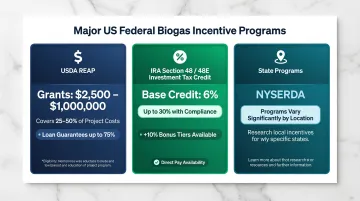
- USDA REAP: Grants of $2,500–$1,000,000 covering up to 25–50% of eligible project costs, plus loan guarantees up to 75% of project costs. Eligible for agricultural producers and rural small businesses.
- IRA Section 48/48E Investment Tax Credit: Base credit of 6%, increasing to 30% with prevailing wage and apprenticeship compliance. Additional 10% bonus available for domestic content or energy community siting. Direct pay available for tax-exempt entities.
- State programs: New York's NYSERDA funds anaerobic digesters through multiple programs; state-level incentives vary significantly by location and project type.
Stacking these programs can substantially cut net CapEx. Tollenaar Holsteins Dairy, for instance, funded a $1.7 million digester using a $500,000 REAP grant plus $250,000 in NRCS EQIP cost-share, with state programs offsetting a significant portion of the remaining cost.
Frequently Asked Questions
What is the cost of biogas plant installation?
Costs range from roughly $1,500–$15,000 for small residential systems to $400,000–$5 million for on-farm and commercial digesters. Full-scale industrial RNG facilities with gas upgrading can exceed $39 million. Key variables are scale, feedstock type, digester technology, and whether gas upgrading to pipeline quality is included.
How do you maintain a biogas plant?
Routine maintenance covers feeding management, mixing system inspections, gas system monitoring, H₂S monitoring, and periodic digester cleaning to remove accumulated sediment. Annual maintenance costs typically run 2–3% of initial capital cost, covering equipment servicing, sludge removal, and engine overhauls approximately every 2.5 years.
Is a home biogas plant worth it?
For households with consistent organic waste streams, yes. Upfront costs of $1,500–$10,000 can be offset by 20–60% reductions in cooking and heating fuel costs plus fertilizer value from digestate, with typical payback periods of 2–7 years. The economics are strongest where displaced fuel costs are high and waste volumes are reliable.
How much biogas can be produced from 1 kg of food waste?
Roughly 0.3–0.5 cubic meters of biogas per kilogram of food waste under typical digestion conditions. Fat-rich waste (cooking oils, grease) reaches the upper end of that range due to high lipid energy content, while starchy or fibrous material yields less.
What is the typical ROI timeline for a biogas plant?
Home systems typically achieve payback in 2–7 years. Commercial and agricultural systems vary more widely, often 4–10 years depending on feedstock, co-digestion strategy, and grant funding. Industrial RNG projects depend heavily on regulatory credit revenues and gas offtake contracts — favorable RIN and LCFS pricing can sharply reduce payback periods.
What permits are required to build a biogas plant in the US?
Typical requirements include:
- Zoning and land use approval
- Environmental review
- Air quality permits
- Solid or liquid waste handling permits
- Utility interconnection agreements (for RNG injection or grid-tied power)
Requirements vary widely by state and project scale — budget 90 days to well over a year for permitting on larger projects.