For facility operators and engineers, understanding COD isn't optional. It drives treatment system design, daily process control, and compliance reporting simultaneously.
This guide covers everything you need: what COD is, what drives it up, how to measure and calculate it, how to reduce it, and what U.S. discharge standards actually require.
TL;DR
- COD measures the total oxygen demand from chemical oxidation of organic and inorganic compounds (reported in mg/L)
- High COD signals organic contamination that depletes dissolved oxygen in receiving water bodies
- Results are available in 2–3 hours vs. 5 days for BOD, making it the preferred metric for real-time process control
- Reduction strategies include coagulation/flocculation, aerobic treatment, anaerobic digestion, and regular tank cleaning
- COD limits are set per NPDES permit, with municipal surcharges typically triggered above 450–800 mg/L
What Is Chemical Oxygen Demand in Wastewater Treatment?
COD is defined as the oxygen equivalent of the organic matter in a sample that is susceptible to oxidation by a strong chemical oxidant. Per U.S. EPA Method 410.4, it represents all oxygen consumed when dichromate ions chemically oxidize the oxidizable material in a sample. Results are expressed in mg/L (milligrams of O₂ per liter).
Higher COD means more oxidizable pollutants are present. When that wastewater reaches a receiving water body, microbial decomposition depletes dissolved oxygen (DO), threatening aquatic life and signaling a heavier treatment burden for the facility upstream.
What COD Actually Measures
COD captures two categories of compounds:
- Organic matter — food waste, fats, oils, greases (FOG), sugars, proteins, hydrocarbons
- Inorganic oxidizable compounds — sulfides, nitrites, ferrous iron, and ammonia
This dual coverage is why COD is consistently higher than BOD for the same sample. Chemical oxidation by dichromate is more complete than biological oxidation by microorganisms. BOD only captures the fraction that microbes can consume in five days.
Why COD Is a Critical Operational Parameter
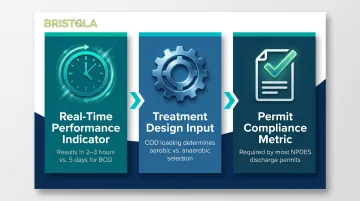
COD operates across three distinct layers in any treatment facility:
- Real-time performance indicator — delivers results in 2–3 hours, versus the 5-day wait for BOD
- Treatment design input — COD loading determines whether aerobic or anaerobic treatment is the right fit
- Permit compliance metric — required by most environmental discharge permits as a direct or surrogate measure
For high-strength industrial streams, this matters even more. Typical domestic wastewater COD ranges from 500 mg/L (low strength) to 1,200 mg/L (high strength) according to Metcalf & Eddy benchmarks. Industrial streams far exceed those figures. Slaughterhouse wastewater reaches 1,000–15,000 mg/L, and dairy wastewater has been measured as high as 95,000 mg/L in concentrated process streams. These concentrations directly shape treatment system sizing, process selection, and the cleaning frequency required to keep tanks performing at capacity.
What Causes High COD in Wastewater?
Organic Pollutants
The primary driver in most facilities is organic matter. In food processing, dairy, slaughterhouse, and municipal wastewater, the main contributors are:
- Fats, oils, and greases (FOG)
- Sugars and starches
- Proteins from meat and dairy processing
- Food waste solids that dissolve into the liquid phase
These carbon-based compounds exert high oxygen demand when chemically oxidized, which is why food and beverage processing wastewater typically runs 1,450–2,200 mg/L COD.
Industrial Process Chemicals
Solvents, dyes, detergents, and petroleum-based compounds widen the gap between COD and BOD. These chemicals are chemically oxidizable (the dichromate reagent breaks them down), but microorganisms in the BOD test often can't degrade them.
A BOD/COD ratio below 0.25 indicates significant non-biodegradable content. Textile wastewater with synthetic dyes can reach COD:BOD ratios of 5:1 or higher. That ratio matters for treatment selection — biological processes alone won't resolve the problem.
Accumulated Sludge in Tanks and Digesters
Most facilities focus on influent quality and overlook what's already inside the tank. As solids build up on the floor and walls of digesters and storage tanks, they undergo slow hydrolysis — continuously re-releasing dissolved organics back into the liquid phase.
During anaerobic digestion specifically, this hydrolysis and acidogenesis process increases soluble COD even as particulate COD decreases. Accumulated sludge becomes a persistent internal COD source — one treatment processes must continuously work against regardless of what's coming in through the influent.
Operational Failures
Even when influent quality is consistent, these operational issues drive effluent COD up:
- Insufficient mixing leaving dead zones in reactors
- Inadequate aeration reducing aerobic degradation efficiency
- Bypassed treatment stages during maintenance or high-flow events
- Overloaded systems where organic loading exceeds biological capacity
How to Measure and Calculate COD
The Standard Test Method
The APHA Standard Methods 5220 D closed reflux colorimetric method is the most widely used EPA-approved procedure:
- Add sample to a pre-prepared vial containing potassium dichromate (K₂Cr₂O₇) and sulfuric acid
- Digest at 150°C for 2 hours in a block digester
- Read absorbance on a colorimeter at 600 nm (high range) or 420 nm (low range)
- Results expressed as mg/L COD
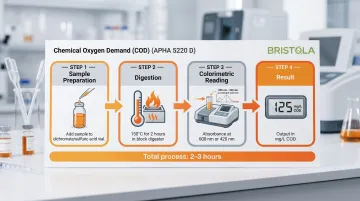
The total process takes 2–3 hours. Vials contain mercury sulfate, silver sulfate, hexavalent chromium, and concentrated sulfuric acid. All are classified as hazardous waste and require disposal at authorized chemical waste facilities.
How to Calculate COD Results
For concentration: the colorimeter reading directly outputs mg/L. If the sample was diluted before testing, multiply the colorimeter reading by the dilution factor.
For pollutant loading — which matters as much as concentration for compliance reporting — use this formula:
Load (lb/day) = Flow (MGD) × Concentration (mg/L) × 8.34
The 8.34 factor converts gallons to pounds. A facility discharging 2 MGD at 600 mg/L COD carries a daily load of 10,008 lb/day. Permit surcharges are typically calculated on excess loading above a threshold, not just concentration. That means this calculation directly determines your surcharge exposure.
Establishing a COD:BOD Ratio
That loading calculation becomes even more useful when paired with BOD data. Once you collect multiple paired COD and BOD readings from the same wastewater stream, the consistent ratio between them lets COD predict BOD in near real-time. That eliminates the 5-day wait for operational decisions.
| Wastewater Type | Typical COD:BOD Ratio |
|---|---|
| Food processing | ~2:1 |
| Municipal sewage | 1.8–2.3:1 |
| Textile/dye-heavy industrial | 5:1 or higher |
For streams with ratios above 3:1, biological treatment alone will leave a significant residual COD load. That gap represents non-biodegradable compounds that require chemical treatment.
COD vs. BOD: Key Differences
| Parameter | BOD | COD |
|---|---|---|
| What it measures | Oxygen consumed by microbial degradation | Total oxygen demand from chemical + biological oxidation |
| Test duration | 5 days | 2–3 hours |
| Captures inorganic oxidizables | No | Yes |
| Affected by toxicity | Yes — toxins suppress microbial activity | No |
| Regulatory standard | Primary metric under 40 CFR Part 133 | Operational tool; can substitute BOD per 40 CFR 133 with correlation |
COD is always ≥ BOD for the same sample. This holds across all wastewater types and treatment conditions.
Choosing between the two depends on your regulatory requirements and process conditions:
- Regulatory compliance: BOD is the primary metric under 40 CFR Part 133 — secondary treatment standards require BOD₅ ≤ 30 mg/L (30-day average) with minimum 85% removal. COD can substitute in NPDES permits once a long-term correlation is established.
- Toxic influent streams: For wastewater containing biocides, heavy metals, or toxic solvents, COD is the more reliable choice. Toxins suppress microbial activity in the BOD test, yielding skewed results. Chemical oxidation is unaffected.
- Real-time monitoring: Total Organic Carbon (TOC) testing (results in 5–10 minutes) is increasingly used alongside COD for continuous monitoring, though it measures carbon rather than oxygen demand directly.
How to Reduce COD in Wastewater
Chemical Treatment: Coagulation and Flocculation
Coagulants like ferric chloride and alum destabilize charged suspended particles, causing them to clump. Polymer flocculants then aggregate those clumps into larger, settleable flocs removed by sedimentation and filtration.
Documented removal rates for food processing wastewater:
- Alum: 79% COD removal
- Ferric chloride: 73% COD removal
This approach is effective for particulate organic matter and delivers fast results. The tradeoff: ongoing chemical costs and sludge disposal from the settled flocs.
Biological Treatment Methods
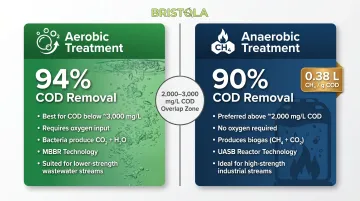
Aerobic treatment suits wastewater with COD below ~3,000 mg/L. Bacteria break down organic compounds into CO₂ and water in the presence of oxygen. Moving Bed Biofilm Reactors (MBBR), which use floating carriers to maximize microbial surface area, have achieved 94% COD removal for slaughterhouse wastewater.
Anaerobic treatment is preferred for COD above ~2,000 mg/L. Microbes convert high-strength organics into biogas (methane + CO₂) without oxygen. UASB reactors can achieve 90% COD removal at appropriate loading rates, with methane yield around 0.38 L CH₄ per gram of COD. For biogas and RNG facilities, this captured methane becomes a revenue-generating energy source, which means digester performance directly affects the economics of renewable energy production.
The Role of Tank Maintenance in Sustaining Low COD
Biological treatment can only perform as well as the vessel it operates in. Accumulated sludge on the floor of an anaerobic digester creates an ongoing internal COD source: solids undergoing incomplete conversion continuously release dissolved organics back into the effluent.
In one documented case, a 1.2 million gallon EnviTec digester that hadn't been cleaned in over four years experienced measurable degradation across every performance metric:
- Volatile solids reduction dropped below 25%
- Lost ability to maintain mesophilic temperature (95–101°F) during winter
- Daily biogas production fell by 20%
Accumulated solids were the root cause in each case.
Regular cleaning is an active COD reduction strategy, not a maintenance afterthought. Facilities that treat it as one pay for it in degraded performance.
Bristola's Submersible Robotic Cleaning System (SRCS) addresses this directly. The system uses a patented Equalization Chamber Entry System: an airlock-type mechanism that replaces the existing manhole cover, allowing a remote-controlled submersible ROV to enter live digesters and storage tanks without draining or shutting down the facility. Sludge is removed via flexible hose while biological treatment continues uninterrupted.
Traditional cleaning requires draining, confined space entry, and production downtime. One analysis puts the downtime revenue loss at $200,000 per cleaning event. Bristola's system eliminates that figure entirely, with annualized costs of $170,000 versus $250,000 for traditional methods, a documented $80,000 savings per tank per year.
COD Discharge Standards and Regulatory Compliance
There is no single national COD limit in the U.S. Discharge standards are established permit-by-permit through the EPA's NPDES program, with limits varying by industry, receiving water body, and local municipal thresholds.
How Limits Are Set
- Technology-Based Effluent Limits (TBELs) — based on what the best available technology can achieve for a given industry
- Water Quality-Based Effluent Limits (WQBELs) — set to protect the specific receiving water body
- Municipal surcharge programs — industrial dischargers to POTWs face surcharges above threshold concentrations
Surcharge Examples
| Municipality | Threshold | Rate |
|---|---|---|
| Wildwood, FL | 450 mg/L COD | $1.08/lb over threshold |
| Clean Water Services (OR) | 800 mg/L COD | $0.21/lb over threshold (2025) |
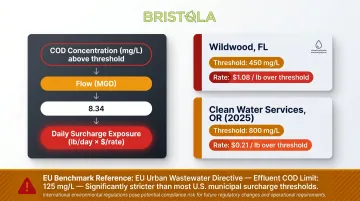
For facilities with international operations, the EU Urban Wastewater Treatment Directive sets a COD limit of 125 mg/L for direct surface water discharge — stricter than most U.S. permit thresholds and worth benchmarking against when evaluating treatment performance.
Consequences of Exceeding Limits
- Surcharge fees calculated on excess loading (lb/day above threshold) — costs scale with both flow and concentration
- Compliance orders requiring corrective action within defined timeframes
- Permit revocation for chronic violations
- Environmental liability for downstream water quality damage
At high-flow facilities, even a modest concentration overage translates to significant daily loading violations. The financial exposure grows fast, and repeated exceedances put permit status at risk.
Frequently Asked Questions
How do you calculate chemical oxygen demand in wastewater?
COD is measured using the closed reflux colorimetric method (APHA 5220 D). After a 2-hour digestion at 150°C, the colorimeter reads the result directly in mg/L. If the sample was diluted, multiply by the dilution factor. For pollutant loading: Flow (MGD) × Concentration (mg/L) × 8.34 = lb/day.
How do you reduce chemical oxygen demand in wastewater?
The two main approaches are chemical treatment (coagulation/flocculation for suspended organics) and biological treatment (aerobic for lower-strength streams, anaerobic above ~2,000 mg/L). Regularly removing accumulated sludge from digesters and storage tanks is equally important — without it, dissolved organics continuously re-enter the liquid phase and offset treatment gains.
What causes high chemical oxygen demand in wastewater?
Primary sources include organic matter from food waste, FOG, sugars, and proteins; industrial chemicals like solvents and dyes that are chemically oxidizable but not biologically degradable; and accumulated sludge in storage tanks or digesters that continuously releases dissolved organics back into the liquid phase.
Why is chemical oxygen demand important?
COD measures total organic pollution load and predicts how much dissolved oxygen the effluent will deplete in receiving water bodies — both critical for protecting aquatic ecosystems. It also drives treatment system sizing and serves as a BOD surrogate for NPDES permit compliance reporting.
What is the standard chemical oxygen demand level?
No universal standard exists. Limits are set by individual NPDES permits based on industry type and receiving water conditions. Typical domestic wastewater COD runs 500–1,200 mg/L by strength category; treated effluent must meet permit-specific thresholds, which can be far stricter for direct surface water discharge.
Should COD be higher than BOD?
Yes, always. COD measures both organic and inorganic oxidizable compounds using strong chemical oxidation. BOD only captures the fraction that microorganisms can degrade in five days. The gap between them represents non-biodegradable organic content and inorganic oxidizable compounds that biological treatment alone won't address.