For industrial and municipal operators, the consequences of getting this wrong extend well beyond regulatory fines. Untreated discharge contaminates drinking water sources, fuels ecological dead zones, and creates public health risks that cost billions annually.
This guide covers what facility managers, environmental compliance officers, and operations leaders actually need to know: the types of wastewater and their sources, how primary, secondary, and tertiary treatment work, the most proven industrial management solutions, emerging technologies reshaping the sector, and — crucially — the maintenance practices that determine whether your treatment systems perform as designed.
TL;DR
- 42% of household wastewater globally goes untreated, creating massive public health and ecological consequences
- Wastewater treatment moves through three stages — primary (physical), secondary (biological), and tertiary (polishing) — each removing a different category of contaminants
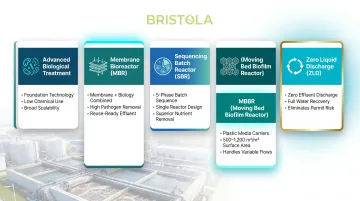
- The five key industrial management solutions are advanced biological treatment, MBR, SBR, MBBR, and ZLD systems
- Energy recovery from anaerobic digestion is underutilized — only ~10% of U.S. plants use it
- Sludge buildup in digesters and tanks degrades performance — robotic cleaning systems now handle this without halting operations
What Is Wastewater Management and Why Does It Matter?
Wastewater management encompasses the collection, treatment, and responsible discharge or reuse of water contaminated through residential, industrial, and agricultural use. It's a technology challenge and an operational discipline in equal measure: even the best treatment infrastructure fails without consistent maintenance and process control.
The Public Health and Environmental Stakes
The human cost of inadequate treatment is direct and measurable. CDC data published in 2025 estimates that waterborne pathogens cause 7.15 million illnesses and 6,630 deaths annually in the U.S. alone, with $3.33 billion in direct healthcare costs. Globally, WHO attributes 1.4 million deaths per year to inadequate water, sanitation, and hygiene.
Nutrient-rich discharge — primarily nitrogen and phosphorus — triggers algal blooms that consume dissolved oxygen and create hypoxic dead zones where aquatic life cannot survive. The EPA has documented more than 166 dead zones in U.S. waters. The Gulf of Mexico hypoxic zone measured 6,705 square miles in 2024, roughly the size of New Jersey — more than triple the long-term reduction target.
The Regulatory Reality
Those environmental stakes are precisely what drove the regulatory framework facilities operate under today. The Clean Water Act's NPDES (National Pollutant Discharge Elimination System) permit program prohibits discharge of pollutants without a permit containing specific effluent limits and monitoring requirements. The penalties for non-compliance are severe: Class II civil penalties can reach $25,000 per day per violation, with knowing violations carrying criminal penalties of up to $50,000 per day and imprisonment up to three years.
Types of Wastewater and Their Sources
Understanding what you're treating matters as much as how you treat it. Contaminant profiles vary dramatically across source categories.
Municipal Wastewater
Households and businesses generate municipal wastewater containing human waste, detergents, pharmaceuticals, food residue, and personal care products. It's managed through centralized treatment plants under mandatory NPDES secondary treatment requirements, making it the most regulated and consistently treated wastewater stream.
Industrial Wastewater
Manufacturing, oil and gas, food processing, steel production, and pulp and paper operations generate wastewater with contaminant profiles that municipal systems weren't designed to handle. Key characteristics by sector:
| Sector | Primary Contaminants |
|---|---|
| Food Processing | High BOD, fats/oils/grease, nitrogen, phosphorus |
| Oil and Gas | Hydrocarbons, high TDS, heavy metals, BTEX compounds |
| Steel/Metal | Chromium, zinc, nickel, acids, suspended solids |
| Pulp and Paper | High BOD/COD, chlorinated organics, heavy metals |
Most industrial dischargers must pre-treat wastewater before it enters municipal systems, governed by EPA Effluent Limitations Guidelines for each sector.
Agricultural Wastewater
Agricultural operations produce the largest volume of wastewater globally. Animal fecal biomass reached 3.12 trillion kg in 2014, compared to 810 billion kg for humans — a ratio of roughly 5:1. In the Americas, that ratio climbs to 11:1.
The treatment gap is structural — and significant. Municipal wastewater faces mandatory NPDES secondary treatment requirements. Most agricultural wastewater, outside of large Concentrated Animal Feeding Operations (CAFOs), is managed through best practices rather than treatment plant infrastructure. When animal wastewater reaches streams, it tends to be more concentrated than its municipal counterpart, causing severe localized pollution even at smaller volumes.
Primary, Secondary, and Tertiary Wastewater Treatment Explained
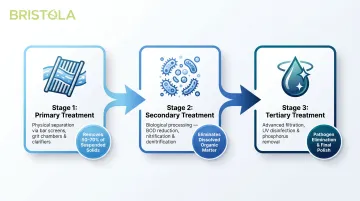
Modern wastewater treatment follows a three-stage progression, each targeting different contaminant types.
Primary Treatment: Physical Separation
The first stage removes gross solids through physical means:
- Bar screens capture rags, plastics, and large debris entering the plant
- Grit chambers settle sand and heavy particles that would abrade downstream equipment
- Primary clarifiers use gravity sedimentation to separate settleable solids (sludge) and floating materials (grease and oil scum) from the liquid stream
Primary treatment typically removes 50-70% of suspended solids but leaves dissolved organics and nutrients largely untreated.
Secondary Treatment: Biological Processing
Aerobic bacteria in aeration basins consume dissolved organic material, reducing biochemical oxygen demand (BOD). Anoxic zones introduce denitrifying bacteria that convert nitrates to harmless nitrogen gas. The combined process handles:
- BOD reduction (dissolved organic matter)
- Nitrification (ammonia → nitrates)
- Denitrification (nitrates → nitrogen gas)
- Secondary clarifiers separate remaining solids from the treated liquid
Tertiary Treatment: Polishing
Tertiary treatment addresses what secondary treatment leaves behind : residual phosphorus, pathogens, endocrine-disrupting compounds, and pharmaceuticals. Methods include advanced filtration, UV disinfection, chemical phosphorus precipitation, and reverse osmosis. The output meets standards for sensitive environmental discharge or direct reuse.
One emerging limitation: PFAS compounds cannot be removed by conventional biological treatment. Only granular activated carbon, ion exchange resins, and high-pressure membranes have demonstrated effectiveness — creating a growing compliance challenge as EPA sets new PFAS discharge standards.
Sludge and Energy Recovery
Solids separated throughout treatment undergo digestion. Anaerobic digestion (the breakdown of organic material without oxygen) produces biogas composed of 60-70% methane, which can fuel the plant's own operations. Remaining biosolids are land-applied as soil amendment, incinerated, or landfilled.
Wastewater contains roughly five times the energy needed for its own treatment, yet only about 10% of U.S. treatment plants use anaerobic digestion — and of those, roughly one-third flare all resulting biogas rather than capturing it.
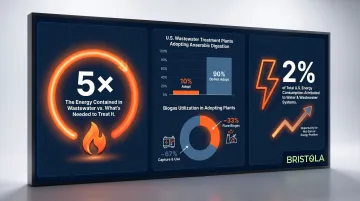
That waste happens at scale. Water and wastewater systems account for approximately 2% of total U.S. energy use and 30-40% of municipal government energy consumption. The case for capturing what's already being produced is hard to argue against.
5 Key Wastewater Management Solutions for Industrial Facilities
These are the most proven treatment and management approaches for industrial and municipal operators facing today's discharge standards and operational constraints.
Advanced Biological Treatment Systems
Biological treatment — using microorganisms to decompose organic waste — forms the foundation of most wastewater management. It reduces chemical usage, produces minimal secondary waste, and scales across facility sizes. For most operations, it's the baseline before evaluating more specialized technologies.
Key reasons biological treatment is typically the first step:
- Proven performance across municipal and industrial applications
- Lower chemical dependency compared to purely physical or chemical methods
- Adaptable to a wide range of organic load levels and flow rates
Membrane Bioreactor (MBR) Technology
MBR combines membrane filtration with biological treatment in a single process. The membranes physically separate treated water from biomass, producing high-quality effluent with very high removal rates for suspended solids, bacteria, and viruses. Research in Water Research (2024) confirmed MBR outperforms conventional activated sludge on pathogen reduction — though safe reuse still requires additional polishing steps.
This makes MBR the go-to choice for facilities targeting water reuse or discharging into ecologically sensitive environments.
Sequential Batch Reactor (SBR) Technology
SBR operates as a time-sequenced batch process within a single reactor, cycling through:
- Fill → React → Settle → Decant → Idle
Each phase handles a specific treatment objective, eliminating the need for separate tanks. The EPA has documented SBR case studies confirming its nutrient removal effectiveness, particularly for biological nitrogen and phosphorus. Space efficiency and operational flexibility are consistent advantages — especially for facilities with constrained footprints.
Moving Bed Biofilm Reactor (MBBR) Technology
MBBR suspends plastic HDPE media carriers in the reactor, providing surface area of 500–1,200 m²/m³ for biofilm growth. Bacteria colonize the carrier surfaces rather than remaining in suspension, which means MBBR maintains its biomass regardless of hydraulic changes — no sludge recirculation required.
For industrial facilities with variable wastewater flows, that biomass stability matters. MBBR handles high organic loads in a compact footprint and keeps performing through the flow fluctuations that trip up other systems.
Zero Liquid Discharge (ZLD) Systems
ZLD is the most stringent option: all wastewater is treated and recovered for reuse, with zero effluent discharged to the environment. No effluent means no permit violations — discharge compliance risk is eliminated entirely.
The tradeoff is capital intensity. ZLD systems require evaporators and crystallizers with significant upfront costs. Adoption is accelerating in sectors facing both strict regulations and water scarcity:
- Power generation
- Mining
- Textiles
- Chemical manufacturing
Sustainable and Emerging Technologies in Wastewater Management
Energy Recovery: From Consumer to Producer
A small number of facilities have demonstrated that net energy production is achievable. East Bay Municipal Utility District in Oakland became the first wastewater facility in North America to achieve net energy producer status, generating approximately 11 MW through anaerobic digestion and co-digestion of food processing waste. DC Water's Blue Plains facility generates roughly 10 MW from biogas turbines, replacing about one-third of purchased electricity.
Solar installations on facility land and hydraulic turbines on effluent flows offer additional generation pathways for plants not yet able to implement full anaerobic digestion programs.
Nutrient Recovery as Revenue
Nitrogen and phosphorus recovered from wastewater effluent can be processed into agricultural fertilizers, turning a pollution liability into a saleable product. Struvite recovery is currently the most mature approach at commercial scale. Companies like Ostara operate full-scale systems at treatment facilities, recovering these nutrients before they trigger costly discharge violations.
SCADA and Smart Monitoring
Supervisory Control and Data Acquisition (SCADA) systems provide real-time visibility across a facility's core variables:
- Water quality and flow rates tracked continuously against permit thresholds
- Equipment performance flagged automatically before failures occur
- Energy consumption monitored to identify waste in real time
IoT sensors combined with cloud-based SCADA platforms automate responses to process changes, cutting chemical use and strengthening compliance documentation. One IWA-published study documented a 96.3% wastewater recycling rate in an IoT-enhanced SCADA system.
Frontier Technologies
SCADA and nutrient recovery optimize what existing treatment systems already do. For contaminants conventional biology can't handle, two newer approaches are gaining ground:
- Microbial fuel cells (MFCs) convert organic waste directly to electricity during treatment. The largest air-cathode MFC ever tested at pilot scale was reported in Water Research (2022) — still early-stage, but commercially viable prototypes are advancing.
- Constructed wetlands, activated carbon systems, and aquaponic integration are showing results for removing endocrine disruptors and PFAS that biological treatment cannot handle.
Wastewater Facility Maintenance: The Critical Factor Most Guides Overlook
Advanced treatment technology only performs as designed when the tanks and digesters housing it remain in working condition. Sludge and sediment accumulation is an inevitable operational reality — and when it's ignored, the consequences compound.
What Happens When Tanks Go Uncleaned
In a documented case involving a 1.2 million gallon EnviTec anaerobic digester that hadn't been cleaned in over four years, the facility experienced measurable degradation across every performance metric:
- Volatile solids reduction dropped to less than 25%
- The digester could not maintain mesophilic temperature (95–101°F) during colder months
- Daily biogas production dropped by 20%
This pattern is consistent with the broader research: sludge accumulation reduces the digester's active volume, which reduces biogas yield, which reduces revenue — all while the underlying problem grows.
The Traditional Maintenance Problem
Conventional tank cleaning requires draining the vessel, halting production, and sending workers into confined spaces. From 2011 to 2018, 1,030 workers died from occupational injuries in confined spaces, with inhalation of toxic gases — hydrogen sulfide, carbon monoxide, and methane — among the leading causes. The cost isn't only human. Traditional anaerobic digester cleaning carries direct costs of approximately $300,000, plus $200,000 in lost revenue during the cleaning process, and additional expenses for chemical treatment and temporary storage — totaling around $250,000 annualized.
Bristola's Robotic Cleaning Alternative
Bristola developed its zero-human-entry robotic cleaning system specifically because founder Jared Burma experienced firsthand how dangerous traditional tank entry could be. That experience led directly to a system that eliminates human entry and keeps facilities running during cleaning. The system uses a remote-controlled submersible ROV that enters tanks through a patented equalization chamber entry port — adaptable to any manhole 24 inches or larger — while the facility remains in active operation.
The system services anaerobic digesters, covered lagoons, wastewater treatment tanks, and biogas digesters across municipal, food processing, pulp and paper, and renewable energy sectors. Clients including Sioux City's wastewater treatment facility and major biogas operators like Brightmark and Vanguard Renewables have used the system in production environments.
The table below shows how the two approaches compare across the factors that matter most to facility operators:
| Traditional Cleaning | Bristola Robotic Cleaning |
|---|---|
| Tank must be drained | Tank remains full and operational |
| Workers enter confined space | Zero human entry |
| Days to weeks of downtime | No production interruption |
| ~$250,000 annualized cost | ~$170,000 annualized cost |
| Every 5+ years (reactive) | Annual subscription available |
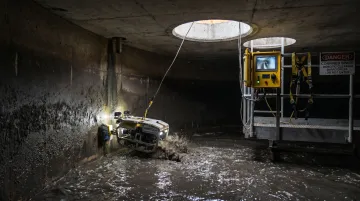
The operational advantages extend beyond the cleaning itself. The system captures and reports data on facility condition and performance, giving operators ongoing visibility into sediment accumulation, structural condition, and operational trends. For uncovered ponds and lagoons, Bristola also offers standalone sediment mapping using sonar and GPS technology — producing 3D renderings with sediment volume, depth measurements, and infilling rate data that facility managers use to plan and budget for dredging.
Retrofitting existing facilities starts with an initial manual clean to prepare the tank, followed by installation of the entry portal on the facility's existing manhole. Once installed, the system provides access for years of subsequent cleanings without draining or downtime.
Frequently Asked Questions
What are the 5 solutions to waste management?
The five key wastewater management solutions are: advanced biological treatment (microorganism-based decomposition), MBR (membrane filtration combined with biological treatment), SBR (time-sequenced batch reactor for nutrient removal), MBBR (biofilm-based treatment on plastic media carriers), and ZLD (zero liquid discharge, full wastewater recovery with no effluent).
What are the main types of wastewater?
The three primary types are municipal (household and commercial waste), industrial (manufacturing, oil and gas, food processing, metals), and agricultural (livestock waste and irrigation runoff). Each has a unique contaminant profile and corresponding regulatory treatment requirement.
What is the difference between primary, secondary, and tertiary treatment?
Primary treatment removes solids physically through screening and sedimentation. Secondary treatment uses biological processes to reduce BOD and convert nitrogen compounds. Tertiary treatment polishes the effluent, removing phosphorus, pathogens, and emerging contaminants to meet reuse or sensitive-discharge standards.
How does poor wastewater management affect the environment?
Nutrient-rich discharge causes algal blooms and hypoxic dead zones that kill aquatic life. Untreated discharge contaminates drinking water sources, introduces endocrine-disrupting compounds into ecosystems, and generates greenhouse gas emissions from decomposing organic waste.
What industries generate the most industrial wastewater?
High-volume generators include food and beverage processing, oil and gas refining, steel and metal manufacturing, pulp and paper production, and animal agriculture. Each sector produces wastewater with its own contaminant profile requiring sector-specific treatment approaches.
How often should industrial wastewater tanks and digesters be cleaned?
Anaerobic digesters should be cleaned at least once every five years at minimum, though optimal frequency depends on influent characteristics and operational load. Bristola's robotic cleaning systems make annual maintenance practical, with no draining or downtime required, enabling proactive schedules that prevent performance degradation over time.