Introduction
Subsea pipelines are the circulatory system of global oil and gas production: they transport hydrocarbons across hundreds of kilometers of seabed, often at depths no human can safely reach. When they fail, the consequences are severe.
BSEE Safety Alert 493 documented an 8-inch gas pipeline explosion in January 2025 caused by outside-diameter corrosion — a failure that spread fire across a production deck, damaged life-saving equipment, and forced a full emergency shutdown. The pipeline had exceeded its five-year mechanical integrity test requirement by three years.
Remotely operated vehicles bring cameras, sensors, and intervention tools to depths and conditions no diver can safely reach. This article explains how ROV pipeline inspection works, what it detects, which ROV classes handle which tasks, and why it has become the standard for subsea integrity management in oil and gas.
TL;DR
- Robotic ROV systems clean oil & gas refinery tanks with no human entry into hazardous confined spaces
- Bristola's patented equalization chamber entry technology allows the ROV to access tanks while they remain in active operation
- No production shutdown required — cleaning happens while the tank continues to run
- Zero-human-entry eliminates the confined space risks that have historically made refinery tank maintenance dangerous
- Full-service data monitoring and reporting documents facility condition before, during, and after each cleaning
What Is ROV Pipeline Inspection?
ROV pipeline inspection uses an unmanned, tethered robotic vehicle controlled from a surface vessel to navigate along subsea pipelines and capture video, sensor readings, and diagnostic data about pipeline condition — without requiring any human to enter the water.
That distinction matters because of where modern pipelines actually operate. TechnipFMC holds the record for the deepest installed flowline at 2,961 meters at Shell's Perdido development in the Gulf of Mexico — roughly six times deeper than the maximum practical limit for saturation diving. The global offshore pipeline market, valued at $13.97 billion in 2022, is projected to reach $19.51 billion by 2030, with infrastructure pushing further into ultradeep water every year.
What ROV Inspection Covers
ROV pipeline inspection is not a single task. It spans multiple mission types governed by DNV-RP-F116, the industry standard for submarine pipeline integrity management:
| Inspection Type | What It Assesses |
|---|---|
| General Visual Inspection (GVI) | Coating damage, anode condition, gross defects, leaks |
| Close Visual Inspection (CVI) | Weld anomalies, specific damage areas, detailed surface condition |
| CP Survey | Cathodic protection levels and corrosion current measurement |
| Ultrasonic Testing (UT) | Pipe wall thickness and remaining material |
| Burial/Span Survey | Free spans and pipeline burial depth via sonar |
| Leak Detection | Hydrocarbon seepage and fluid releases |
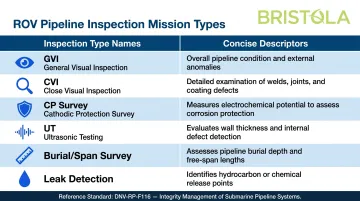
Taken together, these mission types position ROVs as a comprehensive asset management platform — covering everything from surface coating to structural wall integrity across a pipeline's full lifecycle.
Why Traditional Pipeline Inspection Methods Fall Short
Why Traditional Tank Cleaning Methods Fall Short
Traditional tank cleaning methods carry three constraints that operators in Oil & Gas, wastewater, and renewable energy have struggled with for decades.
Confined space entry risk. Sending workers into liquid storage tanks, digesters, or covered lagoons exposes them to toxic atmospheres, oxygen deficiency, and engulfment hazards. OSHA confined space fatalities remain a persistent problem across industrial sectors — and the liability exposure for facility operators is significant.
Production downtime. Conventional drain-and-clean methods require shutting down the tank, emptying contents, ventilating the space, and managing waste removal before any cleaning begins. For anaerobic digesters and refinery tanks operating continuously, that means days or weeks of lost output per cleaning cycle.
Inconsistent results and rising costs. Manual cleaning crews produce variable outcomes depending on crew size, access constraints, and time pressure. Labor costs, temporary storage logistics, and waste disposal fees compound quickly — with no guarantee the facility performs better afterward.
The Sediment Accumulation Problem
In liquid storage tanks — particularly anaerobic digesters, covered lagoons, and refinery storage vessels — sediment buildup is continuous. Left unaddressed, it reduces active volume, disrupts biological processes in biogas digesters, and forces more frequent full cleanouts.
The traditional response is reactive: wait until performance degrades, then schedule a full shutdown. That cycle costs operators far more in lost production and emergency response than a proactive maintenance approach would.
Seasonal and operational peaks add pressure. High-load periods are exactly when facilities can least afford downtime — yet those are often when sediment accumulation accelerates fastest.
How ROV Pipeline Inspection Works
Phase 1: Pre-Survey Planning
Before any ROV enters the water, teams define inspection objectives — GVI or CVI, which DNV categories apply, which sensor packages are required. Existing pipeline records, route maps, and HSE requirements are reviewed. This planning phase directly determines data quality; a poorly defined survey scope produces poorly actionable data.
Phase 2: Deployment and Navigation
The ROV launches from a support vessel via an umbilical — a tether carrying power, control signals, and real-time data. ROV pilots use joystick and computer interfaces to navigate the vehicle along the pipeline corridor. Advanced thruster configurations maintain station-keeping even in strong currents, keeping data consistent and repeatable at pipeline crossings, riser bases, and tie-in points.
Phase 3: Active Inspection
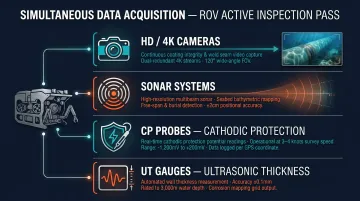
During the survey pass, multiple data streams run simultaneously:
- HD/4K cameras capture continuous video of weld joints, coating condition, and supports
- Sonar systems map seabed interaction, free spans, and burial depth
- CP probes measure cathodic protection levels — modern systems survey at 3–4 knots vs. sub-1-knot speeds with traditional methods
- UT gauges measure remaining pipe wall thickness to ±0.1mm accuracy at depths to 3,000 meters, through coatings, without any pipeline shutdown
Phase 4: Real-Time Monitoring and Post-Survey Reporting
As Phase 3 data collection runs, all video, sensor readings, and positional information stream live to the surface team. Engineers can flag anomalies immediately and direct the ROV pilot to reinspect specific areas on the same dive — rather than scheduling a second mobilization.
Post-survey, analysts classify anomalies by severity, generate geolocated defect maps, and produce timestamped records that satisfy regulatory audit and compliance requirements. Maintaining thorough documentation supports both internal review and third-party verification, giving operators a defensible record of asset condition over time.
Key Capabilities That Make ROVs Effective
High-Resolution Visual Systems
Modern work-class ROVs carry HD and 4K cameras with pan-and-tilt mounts and high-intensity LED arrays designed for sediment-laden, zero-ambient-light environments. These systems detect surface corrosion, coating loss, weld anomalies, and marine fouling that lower-resolution equipment would miss.
Multi-Sensor Integration
A single ROV pass produces layered data:
- Sonar for free-span detection and seabed mapping
- Hydrocarbon sniffers for micro-leak identification
- Laser scanning for precise dimensional measurement
- CP probes for corrosion current assessment
- UT gauges for wall thickness measurement
Manipulator Arms and Intervention Capability
Work-class ROVs carry hydraulic manipulator arms capable of operating valves, torquing bolts, clearing debris, and performing minor repairs. This extends missions beyond inspection into active maintenance, reducing reliance on costly diving spreads or separate intervention vessels.
ROV Classes Used for Pipeline Inspection
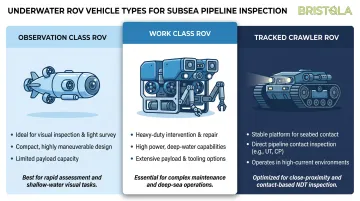
The IMCA classification system defines five ROV categories. Three are directly relevant to pipeline inspection, and understanding each one helps match the right system to the job at hand:
Observation-Class (IMCA Class I/II) Compact, easy to deploy from smaller vessels. Suited for routine visual surveys, coating checks, and shallow-to-moderate depth inspections. Limited tool payload restricts them to pure observation tasks.
Work-Class (IMCA Class III) The standard choice for deepwater pipeline campaigns. Larger and more powerful, these units carry heavy tool skids and manipulator arms rated to 3,000+ meters depth. IMCA data confirms work-class systems account for the majority of offshore oil and gas ROV operations. When inspection findings require immediate intervention (valve operation, CP installation, bolt torquing), work-class ROVs handle it within the same mobilization.
Crawler ROVs (IMCA Class IV) Track- or wheel-mounted units that travel along the pipeline surface rather than free-swimming. Useful for extended corridor surveys, buried pipeline tracking, and environments where current makes free-swimming stability difficult. Also used in specialized applications like UXO detection near pipeline routes.
Benefits of ROV Pipeline Inspection for Oil & Gas Operations
Worker Safety
ROVs remove personnel from the equation entirely. Key hazards disappear with the diver:
- No decompression exposure or nitrogen narcosis risk
- No entanglement hazard in subsea infrastructure
- No physiological limit on mission duration
Inspections can proceed in sea states that would immediately halt diver operations — meaning weather delays no longer create dangerous blind spots in integrity programs.
Operational Continuity
ROV external inspection is non-intrusive. Pipelines stay pressurized and in production throughout. This is the same principle that drives robotic approaches to liquid storage maintenance more broadly — the recognition that taking infrastructure offline for inspection creates costs that can dwarf the inspection itself.
Bristola operates on the same principle for tank cleaning at oil and gas refineries and industrial facilities. Their patented equalization chamber entry system lets a submersible robot enter and clean liquid storage tanks while the facility stays fully operational.
Traditional drain-and-clean methods impose downtime that often costs more than the cleaning itself. Robotic access eliminates that tradeoff.
Regulatory Compliance
BSEE's Pacific OCS Region pipeline inspection program explicitly requires external surveys using ROVs or side-scan sonar, with close-interval CP surveys conducted in conjunction. Under 30 CFR Part 250, operators must maintain complete, timestamped records of all inspections — records that ROV systems generate automatically with geolocation embedded.
That paper trail is not optional. It is the foundation of defensible integrity management when regulators, insurers, or incident investigators review an operator's maintenance history.
Frequently Asked Questions
What is an ROV in oil and gas?
In oil and gas, an ROV (Remotely Operated Vehicle) is an unmanned, tethered robotic system controlled from the surface that performs inspection, maintenance, and repair tasks on subsea infrastructure — including pipelines, wellheads, and platforms — at depths and in conditions that are unsafe or impossible for human divers.
What does ROV stand for in pipeline inspection?
ROV stands for Remotely Operated Vehicle. In pipeline inspection specifically, it refers to a submersible robot that surveys and measures pipeline condition — corrosion, weld integrity, free spans — while operators monitor and control everything from the surface.
How long does an ROV pipeline survey typically take?
Survey duration varies considerably — from one to two days for a short visual inspection to several weeks for a comprehensive multi-sensor survey of a long deepwater corridor. Data analysis and formal reporting add additional time beyond the in-water operation.
What types of defects can ROV pipeline inspections detect?
ROV surveys can identify external corrosion and coating degradation, weld cracks and mechanical damage, free spans and seabed movement, cathodic protection deterioration, anode depletion, sediment accumulation, and hydrocarbon micro-leaks — typically before any of these conditions require emergency intervention.
Are ROV pipeline inspections required by regulations?
Yes. BSEE requires documented subsea pipeline inspections under 30 CFR Part 250, with condition assessments at minimum every 10 years and after significant environmental events. ROV surveys qualify as a compliant method because they generate the traceable, timestamped records these regulations require.