Operators who don't fully understand the sludge removal sequence — how solids are collected, when and how they're extracted, and what happens downstream — tend to make reactive maintenance decisions. That leads to accumulation problems that are expensive to fix and, in some cases, create real safety hazards.
This guide walks through clarifier sludge removal from start to finish: the mechanics, the control strategies, the downstream processing, and what goes wrong when the system falls behind.
TL;DR
- Clarifier sludge is concentrated settled solids that accumulate at the tank floor during wastewater treatment
- Gravity-driven sedimentation separates solids from liquid; mechanical scrapers or suction headers move them to a removal point
- Extraction timing is condition-driven — triggered by timers, flow signals, or sludge blanket sensors rather than a fixed schedule
- Primary sludge (dense, fibrous) and secondary sludge (light biological floc) have different characteristics and handling requirements
- Unremoved sludge creates anaerobic conditions, re-suspends settled solids, and pushes effluent TSS above regulatory limits
What Is Clarifier Sludge?
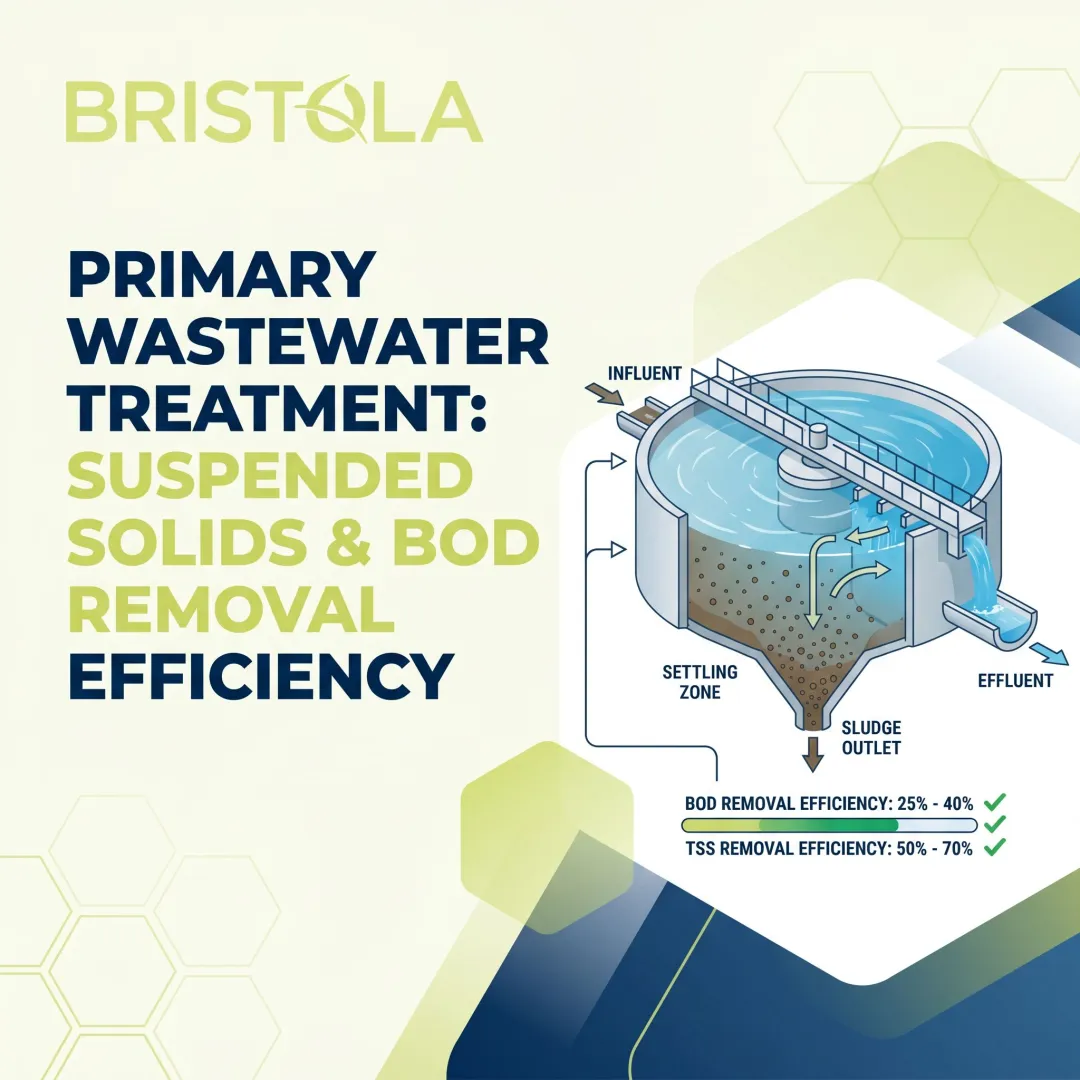
Clarifier sludge is the concentrated layer of suspended solids — organic matter, biological floc, fine particulates, and inorganic material — that settles to the tank floor under gravity during wastewater treatment.
Incoming wastewater carries total suspended solids (TSS) that can't be discharged safely. The clarifier creates the controlled hydraulic conditions needed to separate those solids from the liquid phase.
Primary vs. Secondary Sludge
Not all clarifier sludge is the same, and the distinction matters for how it's handled.
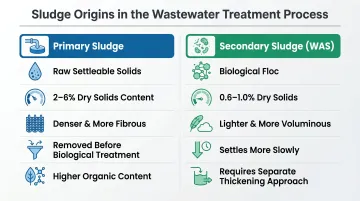
Primary sludge comes from the first stage of treatment, before any biological processing. It consists of raw settleable solids — typically denser and more fibrous, with dry solids content around 2–6% according to Andreoli et al.'s Sludge Treatment and Disposal.
Secondary sludge (waste activated sludge, or WAS) is biological floc produced in the activated sludge process. It's lighter, more voluminous, and much more dilute — typically only 0.6–1.0% dry solids. It settles more slowly and requires different collection and thickening approaches.
What Clarifier Sludge Is Not
Two common points of confusion:
- Scum — fats, oils, grease, and floating solids — collects at the water surface and is removed by a separate skimmer. It doesn't mix with bottom sludge.
- Biosolids — the term for sludge that has completed downstream stabilization and pathogen reduction. Raw clarifier sludge isn't biosolids yet.
Sludge concentration and composition shift based on influent characteristics, hydraulic retention time, and whether chemical coagulants were added upstream. Chemically enhanced primary treatment (CEPT) can boost TSS removal substantially, but it also increases sludge volume — which means pumping, thickening, and disposal capacity all need to be sized accordingly.
How Do Wastewater Treatment Clarifiers Remove Sludge?
Clarifier sludge removal follows a straightforward physical sequence: solids settle to the floor, a mechanical system moves them to a collection point, and the concentrated sludge is extracted while clarified water exits over the overflow weirs.
Settling: How Solids Reach the Bottom
Sedimentation starts at the inlet. In circular clarifiers, wastewater enters at the center through a feedwell; in rectangular designs, it enters at one end. In both cases, the flow slows dramatically. Primary clarifiers typically operate at 1.5–2.5 hours of hydraulic retention time, giving solids enough dwell time to fall out of suspension under gravity.
Design features do a lot of the work here. Energy-dissipating inlets, baffles, and weirs minimize turbulence and promote laminar flow, keeping already-settled particles from being resuspended.
In some installations, inclined tube settlers or lamella plates shorten the effective settling distance, increasing throughput without expanding the tank footprint.
The WEF Sedimentation Fact Sheet notes that feedwells and inlet baffles aren't optional maintenance items — they're core performance controls. A damaged feedwell creates short-circuiting that bypasses much of the available settling time, often doing more harm than the turbulence alone.
Collection: Moving Sludge to a Removal Point
Once solids reach the floor, something has to move them toward a point where they can be extracted. Two main mechanisms handle this:
Scraper systems are standard in circular clarifiers and most primary applications. Slowly rotating arms push settled sludge toward a central hopper at tip speeds around 10 ft/min — slow enough to avoid disturbing the settled layer. Torque protection prevents damage if the mechanism hits a blockage.
Suction header systems are more common in secondary clarifiers, where sludge is dilute and needs uniform withdrawal across the tank floor. A manifold of suction headers draws sludge up without a central hopper, distributing the withdrawal load more evenly.
Where hoppers are used without scrapers, the geometry has to do the work: hopper walls must be steep enough — Ten States Standards specify a minimum slope of 1.7 vertical to 1 horizontal — to overcome sludge's natural angle of repose and prevent bridging at the draw-off point.
Extraction: Removing Sludge from the Tank
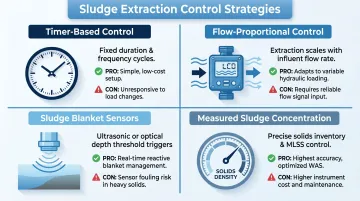
Extraction is typically intermittent rather than continuous. Control strategies vary:
- Timer-based: Fixed duration and frequency, simple to operate but not responsive to actual loading
- Flow-proportional: Withdrawal rate scales with influent flow, better suited to plants with variable loading
- Sludge blanket sensors: Ultrasonic or optical instruments measure blanket depth and trigger withdrawal when it rises above a set threshold
- Measured sludge concentration: Less common, but used where precise control of solids inventory matters
Sludge flows by gravity to the discharge point when there's sufficient hydraulic head. When there isn't, pumps handle the job. The Ten States Standards recommend maintaining at least 3 ft/s in withdrawal lines to prevent solids from settling out in the pipe — with a minimum line diameter of 6 inches and individual valved lines from each hopper to allow isolation and backflushing.
Scum collected by the surface skimmer is routed separately to its own collection trough and doesn't mix with bottom sludge during extraction.
What Happens to Sludge After It Leaves the Clarifier?
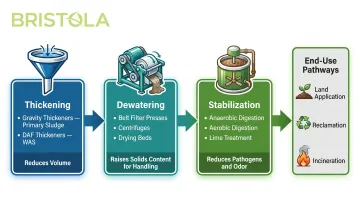
Raw sludge from the clarifier is largely water — primary sludge at 2–6% solids, secondary sludge even more dilute at under 1%. It moves through several downstream stages before it can be disposed of or reused.
Three processing stages follow in sequence:
- Thickening increases solids concentration and reduces volume. Gravity thickeners work well for primary sludge; dissolved air flotation (DAF) thickeners are more common for dilute WAS.
- Dewatering removes additional water using belt filter presses, centrifuges, or drying beds, bringing solids content high enough for handling and transport.
- Stabilization (through anaerobic digestion, aerobic digestion, or lime treatment) reduces pathogens, volatile solids, and odor to levels acceptable for final disposal.
End-Use Pathways for Treated Biosolids
Once stabilized, sludge becomes biosolids and can follow several paths depending on its pathogen class, heavy metal content, and local regulations under 40 CFR Part 503:
- Land application in agriculture or silviculture (Class B biosolids, with site restrictions; Class A without)
- Land reclamation or use as landfill cover
- Incineration where land application isn't viable
RAS and WAS: The Secondary Clarifier Split
Secondary clarifiers in activated sludge systems handle sludge differently from primary clarifiers. Not all the settled biological floc leaves the plant as waste. Instead:
- Return activated sludge (RAS) is pumped back to the aeration basin to maintain the microbial population needed for biological treatment
- Waste activated sludge (WAS) is the excess fraction removed from the system to control solids inventory and sludge retention time (SRT)
The ratio of RAS to WAS is adjusted based on process targets. Operators balance the need to maintain the right mixed liquor suspended solids (MLSS) concentration in the aeration basin while keeping the sludge blanket in the secondary clarifier at an acceptable depth.
Consequences of Inadequate Clarifier Sludge Removal
When sludge isn't removed on schedule — or the removal system can't keep pace with loading — the problems compound quickly.
What Happens at the Tank Floor
Sludge that sits too long goes anaerobic. Bacteria in the oxygen-depleted layer produce gases, including hydrogen sulfide, that can lift settled floc off the floor and carry it into the water column. Dissolved nutrients also release back into the treated water. The result is rising effluent TSS and deteriorating treatment performance.
Both the EPA and WEF emphasize keeping sludge blankets low — typically 1–3 feet in primary clarifiers — specifically to prevent this cascade. Under 40 CFR 133.102, secondary treatment standards require effluent TSS no greater than 30 mg/L on a 30-day average (45 mg/L on a 7-day average), with at least 85% removal. Solids carryover from an over-accumulated clarifier puts that compliance margin at risk fast.
Manual Cleanout: The Fallback No One Wants
When blanket depth rises to the point where it impairs effluent quality, operators face a difficult choice: take the clarifier offline for manual cleanout. That means draining the tank, coordinating worker entry, and cleaning the floor by hand — generating large volumes of liquid waste and significant downtime. It also puts workers in a permit-required confined space with direct hydrogen sulfide exposure risk.
OSHA identifies hydrogen sulfide as rapidly lethal at elevated concentrations, with a flammable range in air of approximately 4.3–45% by volume. Clarifier hoppers and collection pits that have developed anaerobic conditions can accumulate H₂S at dangerous levels before any entry.
A Different Approach When Standard Systems Fall Short
When a clarifier's built-in removal system has fallen behind — from deferred maintenance, mechanical scraper failure, or abnormally high loading — the conventional response requires taking the unit offline and sending personnel in. That's precisely where Bristola's robotic cleaning system offers a practical alternative.
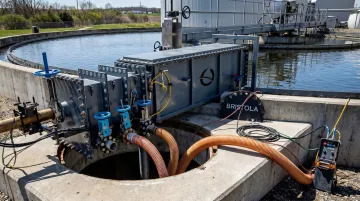
Bristola's zero-human-entry ROV enters through a patented equalization chamber entry system — adaptable to any manhole 24 inches or larger — and vacuums accumulated sludge directly from the floor through a flexible hose to a processing point of choice. The system operates while the facility stays in service. No draining, no confined space entry, no production halt. For a clarifier carrying significant accumulation, that means the unit keeps treating flow while the cleanout happens around it.
Conclusion
Clarifier performance depends on the full chain working — not just settling, but collection, extraction timing, pipeline hydraulics, and downstream processing. Operators who understand each stage make better decisions. They calibrate extraction frequency to actual blanket behavior, catch early accumulation before it compounds, and recognize when the built-in removal system has reached its limits and a more aggressive intervention is needed.
The technical concepts here aren't the hard part. The harder part is consistent execution — and knowing when standard clarifier mechanisms aren't enough to handle what's building up in the tank.
Frequently Asked Questions
What is clarifier sludge?
Clarifier sludge is the concentrated accumulation of suspended solids — organic matter, biological floc, and fine particulates — that settles to the bottom of a clarifier tank during wastewater treatment. It must be regularly extracted to maintain separation efficiency and effluent quality.
How do circular clarifiers remove sludge?
Circular clarifiers use slowly rotating scraper arms, driven by a central mechanism, to sweep settled sludge along the tank floor toward a central hopper or pit. From there, sludge is discharged by gravity or pumping to downstream treatment.
What is the difference between primary and secondary clarifier sludge?
Primary sludge consists of raw settleable solids removed before biological treatment — typically denser, at 2–6% dry solids, and higher in organic content. Secondary sludge is lighter biological floc at 0.6–1.0% dry solids, more voluminous, and often partially recycled as return activated sludge.
How often should sludge be removed from a clarifier?
Frequency depends on influent loading, clarifier design, and solids concentration. Most facilities use timer-based, flow-proportional, or blanket-sensor-driven controls to keep blanket depth below 1–3 feet in primary clarifiers — the threshold where effluent quality begins to suffer.
What happens if sludge is not removed from a clarifier regularly?
Unremoved sludge turns anaerobic, producing gases that re-suspend settled solids and push nutrients back into the water column. Effluent TSS rises, treatment efficiency drops, and the clarifier may eventually require a full offline cleanout — a costly process involving significant downtime and confined space entry risks.
What is the difference between return activated sludge (RAS) and waste activated sludge (WAS)?
RAS is secondary sludge recycled from the clarifier back to the aeration basin to sustain biological treatment. WAS is the excess fraction pulled from the system to control microbial population and sludge retention time, then routed to further treatment.