Introduction
Dairy tanks sit at the center of milk processing, storage, and anaerobic digestion operations — and keeping them clean isn't optional. It's a regulatory requirement with real consequences for product safety and facility compliance.
Organic soils accumulate fast. Milk fats, proteins, and sugars coat tank walls after every use. Mineral deposits — milkstone — build up over days and weeks. Left unaddressed, these residues harbor bacteria that multiply rapidly, degrade product quality, and put facilities at risk of failed inspections, grading penalties, and costly recalls.
Manual cleaning has been the default for decades, but it comes with compounding costs: inconsistent results, high labor overhead, and the documented danger of confined space entry. That last point alone has driven serious injury and fatality incidents across the industry.
This guide covers why cleaning technology matters, the main system types available, how to verify cleaning effectiveness, and how to structure a compliant cleaning schedule.
TL;DR
- Dairy tanks must be cleaned after every use (bulk milk) or on defined cycles — neglect triggers bacterial growth, product loss, and compliance violations
- Cleaning technology ranges from manual washing to CIP spray systems, rotary impingement machines, and zero-human-entry robotic systems
- Effective cleaning depends on four variables: temperature, contact time, chemical selection, and mechanical action
- Traditional CIP systems require tank downtime; robotic systems like Bristola's can clean while tanks stay in active operation
- The average food recall costs approximately $10 million in direct costs; a structured cleaning program costs a fraction of that
Why Dairy Tank Cleaning Technology Matters
What Accumulates — and Why It's Dangerous
Dairy tanks accumulate a specific mix of soils that plain water cannot remove:
- Fats and proteins from fresh milk residues
- Dried/denatured proteins baked on by heat or air exposure
- Milkstone — hard calcium-phosphate deposits bonded with milk proteins that require acid treatment to dissolve
- Biofilm — bacterial communities that form on unclean surfaces and shield microorganisms from sanitizers
Milkstone is particularly problematic. Its rough, porous surface creates microenvironments where bacteria survive sanitizer contact and continue multiplying. According to biofilm research published in the Journal of Dairy Science, biofilm accumulation causes blockages, insufficient heat transfer, and erosion of processing equipment — all of which compound if left unaddressed.
These contamination risks are precisely why regulators have built detailed cleaning requirements into dairy operations law.
The Regulatory Framework
In the US, dairy equipment cleaning is governed primarily by the FDA Grade "A" Pasteurized Milk Ordinance (PMO), 2015 Revision. Key sections include:
- Item 10r — cleaning of all multi-use containers and equipment
- Item 11r — sanitization of product-contact surfaces before each use
- Item 12p — cleaning and sanitizing of milk plant containers and equipment
- Appendix F — detailed methods for chemical, steam, and hot water sanitization
Farm bulk milk tanks must be emptied at least every 72 hours and cleaned when emptied. The PMO works alongside 3-A Sanitary Standards, which govern the equipment design criteria — surface finishes, material selection, and cleanability requirements — that make compliant cleaning physically achievable.
The Financial and Safety Stakes
The financial exposure is substantial:
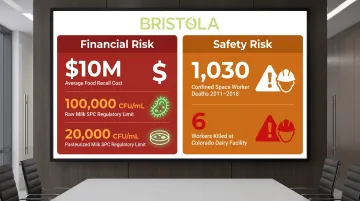
- The average food recall costs $10 million in direct costs alone, with lawsuits and brand damage driving total costs far higher
- The Standard Plate Count limit for individual producer raw milk is 100,000 CFU/mL under PMO Table 1; pasteurized milk must not exceed 20,000 CFU/mL
- Biofilm on heat exchange surfaces reduces thermal efficiency, forcing equipment to work harder and consume more energy
The safety risk runs parallel. Large dairy tanks — including bulk storage vessels and anaerobic digesters — are classified as confined spaces under OSHA 29 CFR 1910.146. In 2025, six workers were killed in a confined space incident at a Colorado dairy, with OSHA subsequently penalizing three businesses. Between 2011 and 2018, 1,030 workers nationally died from injuries involving confined spaces — with agricultural operations overrepresented in that figure.
Every manual cleaning that requires human tank entry carries that same risk.
Types of Dairy Tank Cleaning Technology
Dairy tank cleaning is not one-size-fits-all. The right approach depends on tank size, soiling type, access constraints, and how much downtime a facility can tolerate.
Manual Cleaning
Manual cleaning — buckets, brushes, hand-held spray hoses — remains in use for small lidded tanks where CIP installation isn't cost-effective. Workers physically access interior surfaces to scrub residues.
The limitations are significant:
- High labor cost and inconsistent technique
- Difficult to reach corners, agitators, underbridge areas, and outlet fittings
- Prone to shortcuts under time pressure
- Requires confined space entry protocols for any sealed or large tank
- Unsuitable for large-scale dairy or processing operations
For anything beyond a small farm tank, manual cleaning is an operational liability.
CIP Systems with Spray Balls and Rotary Impingement
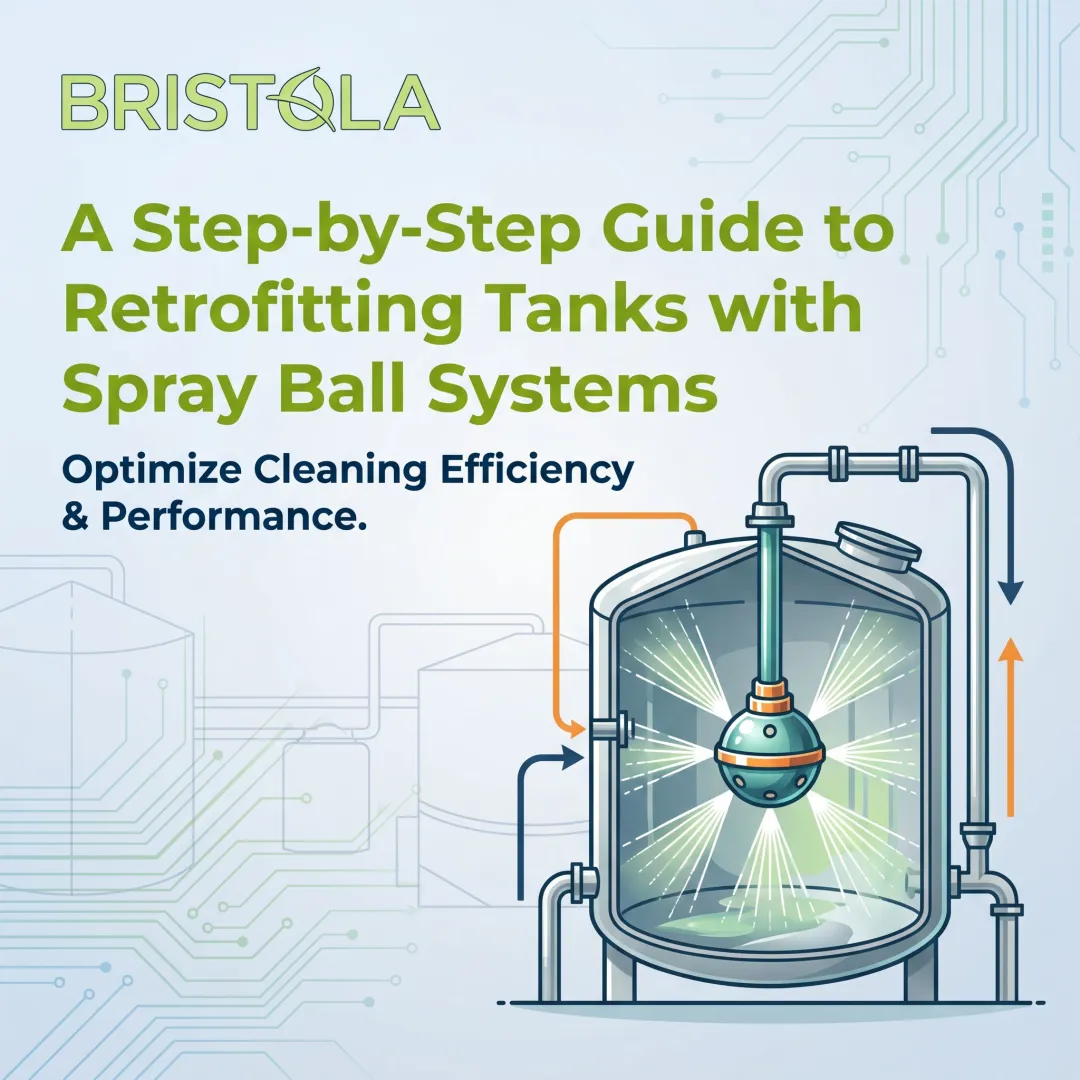
Clean-in-Place (CIP) systems circulate cleaning solutions through fixed or portable devices without disassembling equipment. They are the industry standard for most dairy processing environments.
Two main device types exist:
| Device | Mechanism | Best For |
|---|---|---|
| Static spray balls | Low-pressure flood rinsing across many holes | Light residues, small/medium tanks |
| Rotary impingement heads | High-force rotating jets (2–4 nozzles, 360°) | Heavy residues, milkstone, all tank sizes |
In a documented Alfa Laval case study, replacing three static spray balls operating at 120 gpm over two hours with rotary jet units running at 48 gpm total for 16 minutes achieved an 80% reduction in cleaning time and eliminated the need for manual follow-up cleaning entirely.
CIP systems automate programmed wash cycles — pre-rinse, alkaline wash, acid rinse, sanitizer — with temperature and chemical dosing controls. These automated cycles deliver consistent results, reduced water and chemical use, and minimal labor compared to manual methods.
Known limitations to manage:
- Spray balls can become blocked, leaving surface areas unwashed
- Fixed installations may struggle with tanks that have internal obstructions (agitators, baffles, pipes)
- Facilities should run periodic verification checks to confirm complete surface coverage
Automated Robotic Cleaning
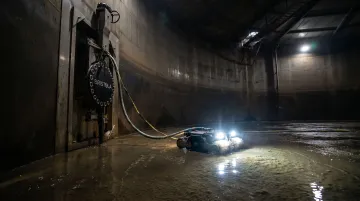
Submersible robotic systems enter tanks through sealed entry ports, requiring no human entry and no tank emptying — the tank stays in active operation throughout the entire cleaning process.
Bristola's patented zero-human-entry robotic system is built for large liquid storage tanks, including dairy anaerobic digesters, covered lagoons, and process vessels. The system deploys a remote-controlled submersible robot through a patented equalization chamber entry port installed on the tank's manhole (compatible with any manhole 24 inches or larger). The robot removes sludge and sediment via vacuum extraction through a flexible hose, with sonar navigation guiding operation in opaque liquid conditions.
The core advantages for large dairy and digester operators:
- No production halt — the tank remains full and operational
- No temporary storage requirements for displaced liquid
- Zero confined space entry — no workers in the tank, ever
- Proprietary data reporting captures facility condition and performance over time
- Retrofit installation available for existing facilities (new builds can integrate the system before commissioning)
In a documented EnviTec digester case, a 1.2-million-gallon digester that hadn't been cleaned in over four years — with biogas yield down 20% and volatile solids reduction below 25% — was successfully cleaned and restored to full operating performance.
Bristola's cost analysis shows the system delivers approximately $80,000 in annual savings per tank compared to traditional drain-and-clean methods, factoring in downtime costs, temporary storage, and labor.
Bristola's clients in the food processing and anaerobic digester sectors include JBS, Vanguard Renewables, and Maas Energy Works — operations where uninterrupted throughput directly drives revenue.
How to Tell If Your Dairy Tank Is Being Cleaned Effectively
Cleaning a tank does not guarantee it has been cleaned effectively. Both performance indicators and physical signs need monitoring.
Performance and Output Indicators
Declining output quality is usually the first signal. Watch for:
- Rising Standard Plate Count in bulk milk — the PMO sets the limit at 100,000 CFU/mL for individual producer raw milk and 20,000 CFU/mL for pasteurized milk; consistent readings trending toward these thresholds signal a cleaning problem before a compliance failure occurs
- Off-flavors or odors in processed dairy products
- Reduced gas yield or inconsistent volatile solids reduction in anaerobic digesters
- Cooling inefficiency in refrigerated tanks, which can indicate biofilm-related heat transfer degradation
Operational signals from the CIP system itself matter too. Wash cycle temperatures dropping below 55°C during the discharge phase compromise cleaning effectiveness — that threshold keeps fats emulsified and prevents redeposition. Operational signals from the CIP system itself matter too. Wash cycle temperatures dropping below 55°C during the discharge phase compromise cleaning effectiveness; that threshold keeps fats emulsified and prevents redeposition. Cycles completing ahead of schedule or depleted chemical concentrations before cycle end both point to system faults.
Physical Signs and Verification Methods
Physical indicators that warrant immediate action:
- White or grey milkstone scale on internal walls
- Visible biofilm formation or residue buildup around agitators or outlet valves
- Deteriorating rubber seals or gaskets that trap soil
- Residue in corners or underbridge areas that spray systems routinely miss
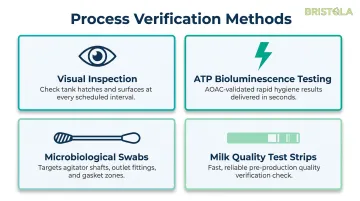
Verification methods to use routinely:
- Visual inspection through tank hatches at each cleaning interval
- ATP bioluminescence testing — AOAC-validated rapid hygiene testing that provides results in seconds, confirming whether organic residues remain on surfaces before production resumes
- Microbiological swabs of high-risk surfaces (agitator shafts, outlet fittings, gasket zones)
- Milk quality test strips as a quick pre-production check
Document all results against benchmark thresholds. The goal is trend detection: catching gradual deterioration early, before it triggers a compliance failure or milk grading downgrade.
When to Escalate
Repeated bacterial count alerts, milk grading downgrades, or the need for manual rescue cleans after automated cycles all signal that the current cleaning approach is no longer adequate. At that point, reassess chemical formulations and cycle parameters. For large tanks with persistent coverage gaps, upgrading to a higher-impact cleaning system is worth evaluating.
Dairy Tank Cleaning Schedule Guidelines
Cleaning schedules vary by tank type, product handled, and regulatory requirements. The following framework should be verified against applicable local food safety codes and equipment manufacturer guidance.
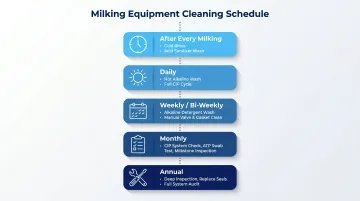
Maintenance Frequency Reference
| Frequency | Required Actions |
|---|---|
| After every milking/collection | Cold water pre-rinse; acid sanitizer wash before next cycle |
| Daily | Hot alkaline or acid wash after milk pickup; full CIP cycle; inspect spray ball or rotary cleaner |
| Weekly / Bi-weekly | Alkaline detergent wash at least twice weekly; manual clean of valves, covers, gaskets, and CIP-excluded components |
| Monthly | CIP system check (flow rates, temps, chemical dosing); ATP or microbiological swab test; inspect for milkstone and seal wear |
| Annual / Major Service | Deep interior inspection; replace worn liners, seals, and gaskets; professional system audit; review cleaning technology for current scale |
The PMO sets a 72-hour maximum interval between bulk tank emptying and cleaning. That's the regulatory minimum, not the operational standard to aim for.
Seasonal Adjustment Triggers
Research confirms that bacterial counts in bulk tank milk are significantly higher in summer months, with elevated SPC, SCC, and coliform counts documented across multiple peer-reviewed studies. Higher ambient temperatures accelerate biofilm formation while simultaneously straining cooling system performance — a compounding risk that standard schedules may not account for.
Intensify cleaning programs when:
- A high bacterial count alert or grading event occurs (prompt an immediate full plant inspection)
- Summer temperatures arrive — increase wash frequency and verify CIP temperatures are being maintained
- Calving periods increase tank throughput
- Any physical sign of milkstone or biofilm accumulation appears between scheduled inspections
Conclusion
Dairy tank cleaning is core operational infrastructure, not optional maintenance. It determines product safety, regulatory standing, heat transfer efficiency, gas yield in digesters, and whether workers come home at the end of a shift.
A structured cleaning program — matched to the tank type, soiling level, and operational scale — costs a fraction of what a product recall, grading penalty, or workplace injury costs. With the average food recall costing $10 million, that math isn't complicated.
As dairy operations scale up and tanks grow larger, manual cleaning and basic spray ball CIP face real limits in safety, coverage, and consistency. Modern operations are shifting to systems that clean without human entry, without halting production, and with documented performance data that proves the job was done. Bristola was founded precisely because that gap was real — Jared Burma nearly died inside a storage tank, and built the company's zero-human-entry ROV technology so no one else would have to take that risk.
For high-throughput dairy waste and biogas operations, automated cleaning is no longer a future consideration. It's an operational decision with a clear timeline.
Frequently Asked Questions
What is used to clean dairy equipment?
Dairy equipment is cleaned using three chemical classes: alkaline detergents (sodium hydroxide) to remove fats, proteins, and carbohydrates; acid cleaners (phosphoric or nitric acid) to dissolve milkstone and mineral scale; and sanitizers (chlorine, iodophors, or peroxyacetic acid) to eliminate residual bacteria. Delivery method depends on equipment type — CIP systems, spray balls, rotary cleaners, or manual washing.
What is the CIP method of cleaning?
CIP (Clean-in-Place) circulates cleaning solutions through tanks, pipelines, and equipment without disassembly, using programmed cycles — typically pre-rinse, alkaline wash, acid rinse, and sanitizer. It reduces labor, improves consistency, and uses significantly less water and chemical compared to manual cleaning methods.
How often should bulk milk tanks be cleaned?
Bulk milk tanks require an immediate rinse after every pickup, a hot wash after each collection, and an alkaline detergent wash at least twice weekly, with an acid sanitizer rinse before the next milking. The PMO mandates tanks be emptied and cleaned at minimum every 72 hours.
What are the dangers of manually cleaning dairy tanks?
The two primary risks are confined space hazards (oxygen deficiency, toxic gas buildup from decomposing organic material, and entrapment) and chemical handling injuries from hot water, caustic alkalines, and acids. OSHA classifies large dairy storage tanks as confined spaces under 29 CFR 1910.146, which requires formal entry permits and safety protocols before any worker enters.
What is the difference between a spray ball and rotary impingement cleaning?
Spray balls use low-pressure flood rinsing across many holes and suit lightly soiled tanks. Rotary impingement machines concentrate flow into two to four high-force rotating jets covering 360 degrees, mechanically breaking down stubborn milkstone, dried proteins, and fermentation products that spray balls cannot dislodge.
Can dairy tanks be cleaned without stopping production?
Traditional CIP systems require the tank to be emptied before cleaning. Advanced robotic systems, such as Bristola's zero-human-entry technology with its patented equalization chamber entry port, clean liquid storage tanks while they remain full and in active operation, removing the need to halt production.