Introduction
Picture two tanks sitting side by side. One hasn't been touched in years — the base is coated in bacterial sludge, the water smells wrong, and the operator is staring down a weeks-long shutdown to get it cleaned. The other runs continuously, its floor cleared on schedule, its contents uncontaminated, its output uninterrupted.
That gap in outcomes comes down to one thing: the cleaning system.
Self-cleaning water tank technology spans a wide spectrum. At one end: simple siphon pipes that cost a few hundred dollars and need no power to operate. At the other: remotely operated robotic systems that enter active industrial tanks through a patented chamber, vacuum the floor clean, and leave without a single worker setting foot inside.
This guide is written for facility managers overseeing liquid storage infrastructure and industrial operators in sectors like wastewater treatment, biogas, food processing, and oil and gas. It covers how these systems work, the main types available, what sludge accumulation costs operators, and where the line falls between light-duty solutions and industrial-grade systems.
TL;DR
- Most industrial systems use robotic vacuums that enter through a sealed port and clean while the tank stays in production — no shutdown required
- Passive siphon systems used in simpler tanks trigger on overflow to pull sludge from the base, with no power or moving parts involved
- Biofilm pathogens in drinking water account for 40% of hospitalizations and 50% of deaths from waterborne disease outbreaks — sediment buildup is a serious health risk
- A single industrial digester clean-out can exceed $120,000 and take over a month, not counting lost production
- The most important feature for industrial facilities: cleaning that doesn't require taking the tank offline
What Is a Water Tank Self-Cleaning System?
A self-cleaning water tank system is any mechanism — passive, semi-automated, or fully automated — that removes accumulated sediment, organic matter, and biological growth from inside a storage tank without emptying it or sending a person in.
What Actually Accumulates Inside a Tank
Even with inlet filters installed, tanks accumulate sediment over time. Industrial inlet screens and pre-filters typically capture particles down to 200–500 microns — meaning anything finer passes straight through. Sub-200-micron particles, smaller than a grain of sand, settle on the tank floor and slowly compact into sludge layers that no filter catches.
Inside that sludge: dust, organic debris, decomposed matter, algae, and — in potable water systems — the conditions bacteria need to establish and grow.
Self-Cleaning vs. Manual Cleaning
That accumulation has to go somewhere. The question is how — and the answer depends entirely on which cleaning approach a facility uses:
- Manual cleaning requires draining the tank (or confined space entry in industrial settings), specialist crews, and a full operational pause
- Self-cleaning systems perform continuous or periodic maintenance without interrupting use — the tank stays in service throughout
For industrial facilities, that operational difference is decisive. Manual cleaning means planned downtime, permitting, confined space crews, and lost production hours. Self-cleaning systems eliminate the shutdown entirely — the tank keeps running while maintenance happens around it.
How Do Self-Cleaning Water Tank Systems Work?
The Passive Siphon Mechanism
The simplest self-cleaning systems rely on a basic principle: when a tank overflows, the rising water level creates pressure. A pipe laid along the tank floor captures that pressure as a siphon effect, drawing contaminated water and bottom sludge up and out through the overflow outlet.
The floor pipe is perforated or slotted along its length so suction distributes evenly across the entire base — no dead zones where sediment can sit undisturbed.
As a reference point, a 50mm siphon pipe moves approximately 2.5 liters per second at 100mm of operating head; a 90mm pipe reaches around 10.1 liters per second at 200mm head. These are indicative engineering benchmarks, not product-certified figures, but the discharge volumes involved are substantial enough to clear meaningful sediment loads per cycle.
The siphon stops automatically when water drops to a preset level — typically through air entry that breaks the vacuum. Only a fraction of stored water is expelled per cycle, preserving the majority of the supply.
Critical limitation: Siphon systems only activate during overflow events. In dry seasons, or in industrial tanks that never overfill, the cycle never triggers. Sludge accumulates unchecked.
Active and Powered Mechanisms
For tanks that run continuously — large anaerobic digesters, covered lagoons, or industrial storage vessels that rarely overflow — passive physics aren't sufficient. Three powered approaches fill that gap:
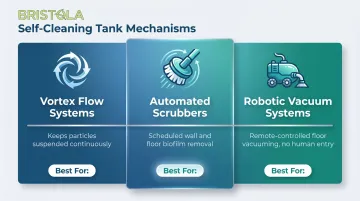
- Vortex flow systems create a continuous circular current that keeps fine particles suspended, preventing settling
- Automated scrubbers use motor-driven brushes to periodically clean tank walls and floors on a schedule — common in food-grade and potable water applications where biofilm control is critical
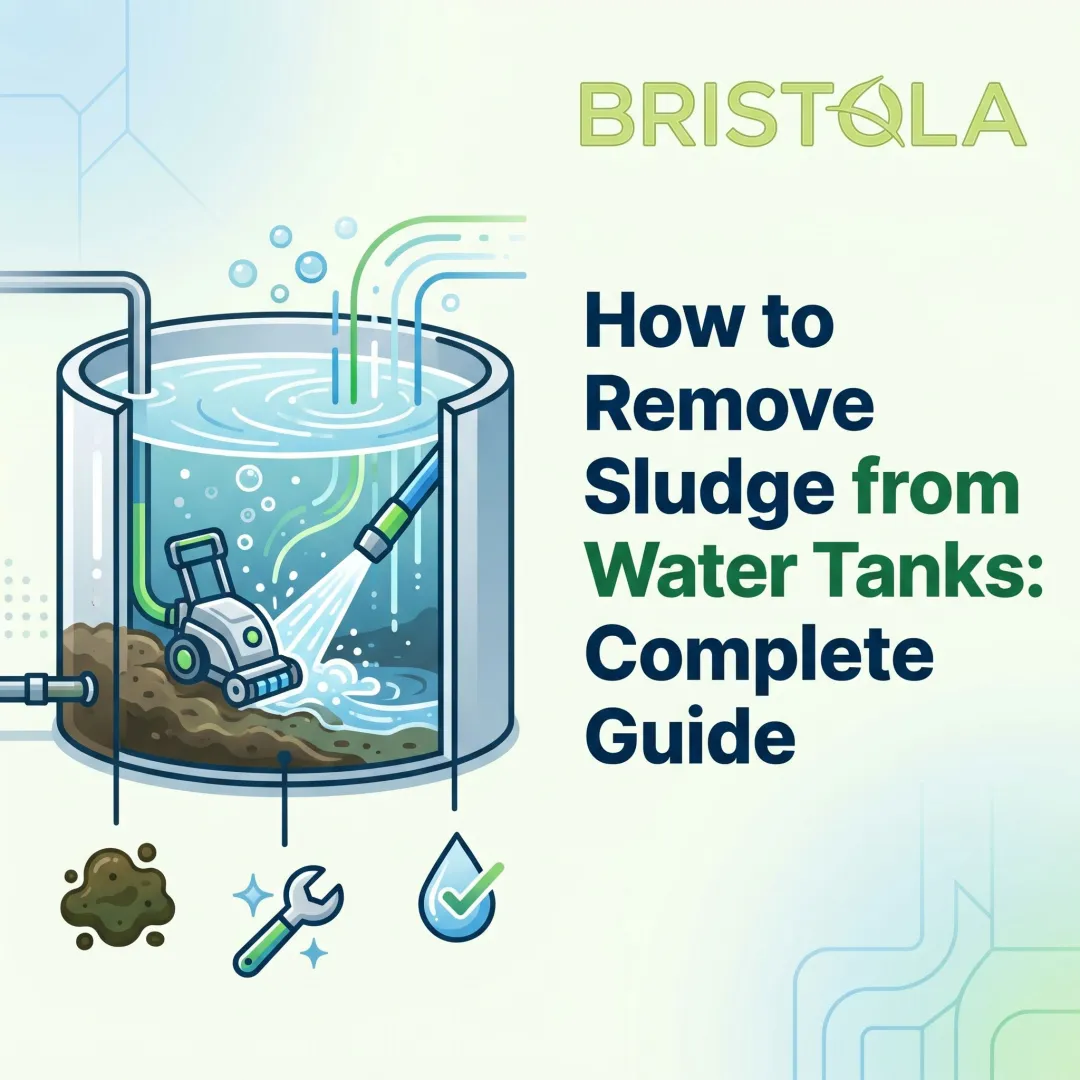
- Robotic vacuum systems deploy submersible robots that physically vacuum the tank floor, controlled remotely by an operator — the standard for large industrial tanks where volume, contents, or hazardous conditions make everything else inadequate
Types of Self-Cleaning Tank Systems
| System Type | Best For | Power Required | Key Strength | Key Limitation |
|---|---|---|---|---|
| Passive siphon/overflow | Residential rainwater tanks | None | Zero operating cost | Only works during overflow events |
| Vortex/rotational flow | Mid-scale commercial storage | Yes | Prevents settling continuously | Less effective on existing heavy sludge |
| Automated scrubbers | Food-grade, potable water | Yes | Biofilm control on walls and floor | Requires periodic mechanical maintenance |
| Robotic vacuum systems | Large industrial liquid storage | Yes | Operates in active tanks, no human entry | Higher upfront investment |
Matching System to Application
Passive siphon systems are the natural fit for residential rainwater tanks. They require no power and carry near-zero operating cost. For a poly or concrete tank filling from roof runoff, overflow events happen often enough to keep the system effective.
Vortex and scrubber systems suit commercial storage with moderate throughput. Both handle mid-scale volumes more consistently than a siphon, and pair well with outlet filters to capture suspended material.
Large industrial liquid storage — anaerobic digesters, wastewater lagoons, oil storage tanks, food processing vessels — requires robotic systems. Siphon physics don't scale to these volumes, and the contents are often too dense or hazardous for passive removal. For facilities where a shutdown carries serious financial and operational consequences, only a system that cleans without taking the tank offline is viable.
Why Sludge and Sediment Buildup Is Costlier Than You Think
Biofilm: The Hidden Health Risk
Sludge isn't passive. It's a biological environment that actively supports bacterial growth. Research published in Environmental Microbiology Reports confirms that biofilms in potable water systems harbor both E. coli and Legionella pneumophila, with biofilm-embedded organisms showing increased resistance to standard disinfectants.
CDC surveillance data puts the downstream consequences in plain numbers: drinking water exposures linked to biofilm pathogens are associated with 40% of hospitalizations and 50% of deaths from waterborne disease outbreaks. In food processing or beverage production tanks, the same contamination risk applies to the product itself, with regulatory consequences layered on top.
The $120,000 Shock of Delayed Cleaning
In an anaerobic digester or wastewater treatment tank, sludge accumulation creates compounding losses across three areas:
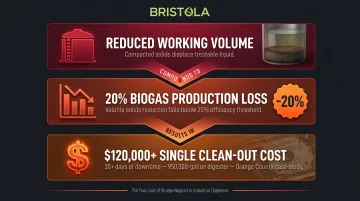
- Reduces working volume — displacing liquid with compacted solids that can't be treated
- Lowers output — a documented case showed daily biogas production declining by 20% in an over-four-year uncleaned digester, with volatile solids reduction dropping below 25%
- Forces unplanned shutdowns — when accumulation becomes severe enough, the only option is a full clean-out
That clean-out cost is where facilities often absorb the real financial blow. A documented case at a regional wastewater treatment plant in Orange County put contractor costs at $120,000 for a single 950,000-gallon anaerobic digester clean-out, with the project taking more than a month to complete. That's before counting lost production revenue.
Why Every Manual Clean-Out Is a Safety Event
Traditional industrial tank cleaning requires human entry. That entry is classified under OSHA 29 CFR 1910.146 as confined space work , one of the most dangerous categories of industrial labor. Requirements include atmospheric testing before entry, a stationed external attendant throughout, and a rescue team on standby.
The U.S. Bureau of Labor Statistics recorded 1,030 confined space fatalities between 2011 and 2018 , averaging around 129 per year and peaking at 166 in 2017. Tanks are explicitly listed among the spaces covered. Every manual clean-out carries this exposure — one that zero-entry robotic systems eliminate entirely.
Industrial Liquid Storage Tanks: Where Self-Cleaning Becomes Critical
Why Passive Systems Don't Scale
Industrial tanks aren't just bigger rainwater tanks. The contents are fundamentally different — slurry, digestate, process water, crude oil — and the geometry often includes covers, complex inlet configurations, and floors spanning tens of thousands of square feet. Siphon physics can't move material that dense. Rotary spray heads, while effective in food-grade applications up to 350 m³, don't reach the scale of a million-gallon digester.
The problem compounds because industrial facilities rarely have the option of "taking the tank offline for a quick clean." A single digester shutdown involves:
- Production halt and tank drainage
- Confined space entry permits and atmospheric monitoring
- Specialist cleaning crews
- Temporary storage for displaced product
- Restart time — days to weeks of lost output
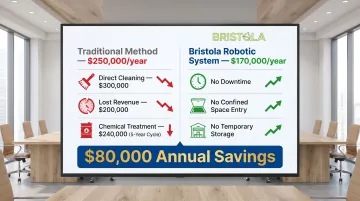
Done every five years on a traditional schedule, Bristola's cost analysis puts the annualized burden at $250,000 per tank — based on per-event costs of $300,000 in direct cleaning, $200,000 in lost revenue, and $240,000 in chemical treatment and storage, spread across the cleaning cycle.
Zero-Human-Entry Robotic Cleaning: The Industrial Answer
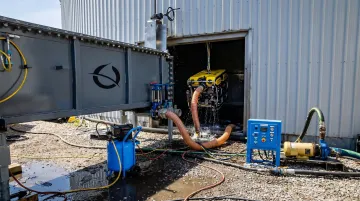
Rather than draining the tank and sending crews in, Bristola's patented robotic cleaning system deploys a remote-controlled submersible ROV through a patented equalization chamber entry system — a specialized entry portal that adapts to any manhole 24 inches in diameter or greater.
The ROV enters on a winch through Bristola's entry box and portal system, reaches the tank floor, and vacuums accumulated sludge through a flexible hose to a processing location of choice. The tank stays full and production continues — no human entry required.
The equalization chamber is what makes this possible: it allows the robot to access an active, liquid-filled tank without depressurizing or draining it — something no traditional cleaning method can do.
The system applies across:
- Anaerobic digesters and biogas/RNG digesters
- Covered lagoons and wastewater treatment lagoons
- Food processing and food and beverage tanks
- Oil and gas storage and refinery tanks
- Pulp and paper industry tanks
- Slaughterhouse and protein processing facilities
- Water treatment facilities
Bristola installs the system on new builds before commissioning or retrofits it to existing infrastructure — though retrofits typically require an initial manual clean-out before the entry system goes in.
What Neglect Costs — and What Recovery Looks Like
The documented EnviTec digester case study — a 1.2-million-gallon, 90-foot diameter digester in New York — shows what neglect costs in performance terms: biogas production down 20%, volatile solids reduction below 25%, and inability to maintain target operating temperature during winter months. After Bristola's cleaning service and system installation, the facility was restored to optimal operating conditions and retrofitted for future live cleanings through the ROV entry port.
On the cost side, facilities using Bristola's annual subscription model report an annualized cost of $170,000 per tank — versus $250,000 under traditional methods. That's $80,000 in annual savings per tank, with no downtime, no confined space entry, and no temporary storage requirements.
What to Look for When Choosing a Self-Cleaning System
Match System Type to Your Tank Profile
Before comparing products, answer these four questions:
- What's in the tank? Clean rainwater needs different treatment than digestate or process slurry
- How often does the tank overflow? Siphon systems are useless if overflow rarely occurs
- Can the tank ever go offline? If a shutdown is operationally acceptable, your options are wider
- Is human entry a legal or safety concern? Confined space regulations add cost and risk to any manual-entry cleaning approach
Consider Retrofit Compatibility
Some systems must be built in during tank construction. Others can be added later. Siphon kits can typically be installed in an existing tank without draining it. Bristola's robotic system can be retrofitted to existing industrial tanks — though the initial installation does involve a preparatory manual clean-out before the zero-human-entry system takes over for all future maintenance.
If your facility can't absorb a shutdown just to install a cleaning solution, ask any vendor upfront about installation logistics and downtime requirements before signing anything.
Evaluate Total Cost of Ownership
Purchase price is the wrong place to start. A $500 siphon kit that can't handle your tank's actual contents costs far more than the sticker price. A single unplanned production shutdown — often running $50,000 or more in lost output and logistics — can dwarf an entire year's robotic cleaning service fee.
The comparison that matters:
| Factor | Passive Siphon | Industrial Robotic System |
|---|---|---|
| Purchase/install cost | Low | Higher upfront |
| Operating cost | Near-zero | Annual subscription |
| Shutdown required? | No | No (after installation) |
| Human entry required? | No | No |
| Effective for large volumes? | No | Yes |
| Handles dense/hazardous contents? | No | Yes |
For industrial facilities, the true comparison is between the total cost of the robotic service and the total cost of doing it the old way: production downtime, confined space entry permits, temporary storage, and the liability exposure that comes with every human entry event.
Frequently Asked Questions
How do self-cleaning water tanks work?
Residential systems typically use a siphon effect triggered by tank overflow — water pressure draws sludge up through a floor pipe and out through the overflow outlet. Industrial systems use robotic vacuums deployed through a sealed entry port to remove sediment while the tank stays full and operational.
Are self-cleaning water tanks worth the cost?
For residential tanks, a basic siphon system typically costs far less than a single professional manual cleaning. For industrial facilities, eliminating downtime and confined space entry can recover the system's cost within one or two avoided shutdown events — at $120,000+ per event, that math moves fast.
What types of tanks can use a self-cleaning system?
Passive siphon systems work best with poly and concrete rainwater tanks. Robotic and automated systems are designed for large industrial tanks — anaerobic digesters, wastewater lagoons, covered lagoons, oil and gas storage, food processing tanks, and similar liquid storage infrastructure.
Can a self-cleaning system be added to an existing tank?
Most can. Siphon kits install while the tank is full. Bristola's industrial robotic system retrofits to existing facilities: an initial manual clean-out is required before the entry system goes in, but all future cleaning happens without draining or human entry.
How often do self-cleaning tanks still need manual cleaning?
A well-functioning system significantly extends cleaning intervals. Residential tanks can go years without manual intervention. Industrial facilities using Bristola's continuous robotic cleaning service on an annual subscription can eliminate scheduled manual clean-outs entirely — no draining, no confined space entry required.
What's the difference between residential and industrial self-cleaning systems?
Residential systems are passive, powerless, and built for small volumes of lightly contaminated rainwater. Industrial systems must handle large volumes of dense or hazardous materials, operate without shutting down production, and — critically — must not require human entry into the tank at any point in the cleaning process.