Sludge and sediment accumulate continuously in these tanks. Left unaddressed, that buildup reduces working volume, disrupts biological treatment processes, and creates dangerous gas hazards that put workers at serious risk. For biogas and RNG facilities, a degraded digester isn't just an operational headache — it's a direct hit to revenue.
This guide covers why regular cleaning matters, the main methods available, warning signs to watch for, a step-by-step process overview, and a practical maintenance schedule to keep your facility running efficiently and in compliance.
TL;DR
- Sludge buildup reduces tank capacity and treatment efficiency; cleaning proactively costs far less than recovering from failure
- Methods range from routine pumping to full manual confined space cleanouts to robotic zero-human-entry systems
- Key warning signs: reduced biogas output, foul odors, slow drainage, elevated effluent turbidity, or abnormal pump run times
- Most industrial tanks need professional cleaning when sludge reaches 25–30% of tank volume, with inspection intervals every 1–2 years
- Robotic zero-entry cleaning keeps the tank online during service, eliminating confined space risk and production downtime
Why Regular Wastewater Tank Cleaning Is Critical
Sludge Buildup Directly Degrades Performance
Every wastewater tank accumulates settled solids over time. Grit, inorganic particles, biological matter — it all sinks. As the sludge blanket grows, the tank's effective working volume shrinks, shortening hydraulic retention time and displacing the active treatment zone.
For anaerobic digesters, the Water Environment Federation notes that accumulated inert solids progressively reduce effective digestion volume — degrading biogas yield and process stability. One Bristola client saw daily biogas production drop 20% and volatile solids reduction fall below 25% after going four years without a cleanout. That's a measurable, direct revenue loss.
The Confined Space Safety Reality
Manual tank cleaning and inspection carry real fatality risk. Bureau of Labor Statistics data recorded 1,030 fatal occupational injuries in confined spaces between 2011 and 2018 — between 88 and 166 deaths per year. Sewers, manholes, and tank interiors consistently rank among the most dangerous categories.
The atmospheric hazards in wastewater tanks are acute:
- Hydrogen sulfide (H₂S): NIOSH sets the IDLH at 100 ppm; OSHA's general industry ceiling is 20 ppm
- Oxygen deficiency: Any atmosphere below 19.5% O₂ is classified as immediately dangerous
- Methane: Flammable and can displace oxygen without warning
Bristola founder Jared Burma's own near-death experience inside a tank — the incident that drove him to build the company — is a firsthand reminder that these aren't theoretical risks.
Regulatory and Financial Exposure
Facilities with degraded treatment performance face real compliance consequences. Recent EPA enforcement under the Clean Water Act's NPDES framework makes the stakes concrete:
- $1.15 million civil penalty against Hanover Foods for repeated permit exceedances
- $400,000 penalty against the City of Driggs, Idaho
- ~$30 million in infrastructure upgrades required of Cahokia Heights, Illinois following improper operation and maintenance
Those penalties dwarf the cost of consistent maintenance. Large digester cleanouts can exceed $100,000 and take more than a month to complete. Bristola's internal cost analysis shows that traditional cleanouts — factoring direct cleaning costs, lost revenue, chemical treatment, and ancillary costs — run approximately $250,000 annualized per tank, compared to roughly $170,000 annualized using a continuous robotic cleaning approach. That's $80,000 in savings per tank, per year.
Wastewater Tank Cleaning Methods
No single method works for every tank. Selection depends on tank type, contents, size, operational constraints, and safety requirements.
Routine Pumping and Desludging
Vacuum truck pumping removes accumulated liquid sludge and floating scum layers — the most common and most affordable option for tanks with moderate buildup and accessible entry points. It works well when:
- Waste streams are liquid-dominant
- Buildup hasn't compacted significantly
- The tank can be taken briefly offline
One key constraint: vacuum pumping can't reach compacted sediment layers, biological film on tank walls, or internal components. It also requires temporary shutdown in most configurations.
High-Pressure Jetting and Hydro-Blasting
High-pressure water jetting breaks up compacted sediment, removes scale, and cleans tank walls and baffles that simple pumping leaves behind. Typically used after initial desludging, or as part of a periodic cleanout.
Jetting usually requires workers to enter or closely approach the tank, which triggers confined space entry requirements under OSHA 29 CFR 1910.146. That standard mandates atmospheric testing, entry permits, standby rescue personnel, and specialized PPE — adding significant labor, time, and compliance cost.
Full Manual Confined Space Cleanout
The most thorough traditional method, and the highest-risk. Technicians enter the tank to remove residual solids, clean all surfaces, and inspect structural integrity. OSHA 1910.146 compliance is non-negotiable.
Required protocols include:
- Atmospheric testing before and during entry
- Issued entry permits and designated attendants
- Standby rescue personnel on site
- Full confined space PPE for all entrants
Operational cost is substantial: the tank must be fully emptied and taken out of service. For biogas digesters and continuous treatment facilities, downtime can stretch weeks and disrupt production significantly.
Robotic and Zero-Human-Entry Cleaning Systems
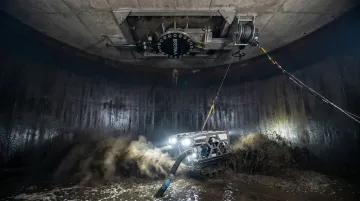
Remote-controlled submersible robotic systems solve both the safety problem and the downtime problem in one deployment. The robot enters through a patented entry port, removes sludge and sediment, and exits — without any human entering the tank or operations stopping.
Bristola's Submersible Robotic Cleaning System (SRCS) uses a patented airlock-type equalization chamber mounted on the tank's existing manhole (24 inches or larger). The ROV deploys via winch, navigates using sonar, and removes material through a flexible hose to the client's chosen processing option — all while the tank stays full and in production.
Key capabilities:
- Compatible with anaerobic digesters, covered lagoons, industrial wastewater tanks, food processing tanks, and more
- Can be installed during new builds or retrofitted to existing facilities
- Full-service system that cleans, monitors, and generates condition reports
- Demonstrated in tanks as large as 1.2 million gallons (90 feet in diameter)
For covered lagoons, initial installation requires a one-time setup involving a prefabricated concrete wall and below-liquid-level manhole. After that, all subsequent cleanings are performed without disrupting operations.
Signs Your Wastewater Tank Needs Cleaning
The right time to clean is before performance degrades noticeably — not after a compliance event or system failure.
Reduced Treatment Performance and Output
Declining treatment efficiency is typically the first sign something is wrong. Watch for:
- Reduced biogas yield in anaerobic digesters
- Slower solids settling in clarifiers
- Increased effluent turbidity or elevated BOD/TSS readings
- Volatile solids reduction dropping below expected thresholds
Elevated effluent parameters can trigger NPDES monitoring flags before the operator connects the issue to sludge accumulation. By the time performance metrics shift noticeably, the tank may already be operating significantly under capacity.
Odor, Overflow, or Drainage Problems
Excess sludge reduces hydraulic retention time — untreated waste passes through faster, leading to:
- Foul odors beyond the facility's normal baseline
- Overflow events at inlet or outlet points
- Backups in upstream collection lines
Unusual odors near the tank may also signal elevated hydrogen sulfide from anaerobic decomposition of accumulated organics. Both are grounds for immediate inspection: one for regulatory compliance, the other for worker safety.
Physical and Instrumentation-Based Warning Signs
Beyond odors and performance dips, physical observation and instrumentation data provide the clearest confirmation. Visible indicators include:
- High sludge blanket levels on routine depth measurements
- Abnormal foam or scum at the surface
- Discolored effluent or visible sediment at outlet structures
Instrumentation signals:
- Frequent alarm activations
- Abnormal pump run times or elevated inlet pressures
- Declining flow rates that don't track with seasonal patterns
Instrumentation changes frequently precede visible symptoms by days or weeks, which is why real-time data monitoring catches accumulation issues before they become compliance events.
How to Clean a Wastewater Tank: Step-by-Step Overview
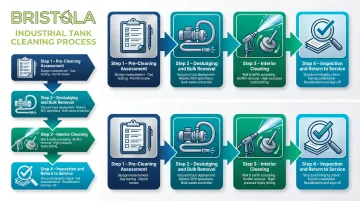
Each step below addresses a distinct phase of the process — from pre-entry hazard assessment through final documentation. Skipping or compressing any phase increases both safety risk and the likelihood of shortened cleaning intervals.
Step 1 — Pre-Cleaning Assessment and Safety Preparation
Before any equipment enters the tank, conditions must be verified and documented:
- Measure sludge blanket depth across the tank
- Test for toxic and flammable gases (H₂S, CH₄, CO) and confirm oxygen levels
- Review confined space entry permits if human entry is planned
- Confirm the selected cleaning method is appropriate for current tank condition
- Notify relevant regulatory bodies if required by permit
Bristola's sediment mapping service uses sonar and GPS technology to produce 3D renderings of sludge volumes, depths, and settlement patterns before work begins — giving crews an accurate baseline before any equipment is deployed.
Step 2 — Desludging and Bulk Waste Removal
- Remove accumulated liquid sludge and scum using vacuum trucks or submersible pumps
- For robotic systems: deploy the ROV through the entry port to begin agitating and extracting settled solids without emptying the tank
With Bristola's system, the robot descends via winch to the tank floor and removes material through a flexible hose — the tank stays in full production throughout, with no need to drain or halt operations before interior cleaning can begin.
Step 3 — Tank Interior Cleaning
Once bulk solids are removed, the focus shifts to surfaces and structures:
- Apply high-pressure jetting or robotic scrubbing to walls, baffles, and inlet/outlet structures
- Remove biofilm, scale, and residual buildup that basic desludging doesn't address
- Confirm all internal components are cleared and accessible for inspection
Step 4 — Inspection, Documentation, and Return to Service
The final step determines both compliance status and the timeline for the next cleaning cycle:
- Inspect structural integrity: check for cracks, corrosion, baffle condition, and inlet/outlet functionality
- Record sludge removal volumes and tank condition in maintenance logs
- Confirm operational parameters are met before returning the tank to full service
- Use condition data to calibrate the next cleaning interval
Bristola's system captures and stores this data automatically, providing clients with condition reports and performance records useful for regulatory compliance documentation.
Wastewater Tank Cleaning Schedule: General Guidelines
Optimal cleaning frequency depends on tank type, organic loading rate, volume, and operational mode. A high-solids biogas digester accumulates sludge far faster than a lightly loaded municipal settling tank. Use the table below as a reference framework, not a fixed rule.
| Frequency | Key Actions |
|---|---|
| Daily / Per-shift | Monitor effluent quality, check for unusual odors or alarms, log pump run times and flow rates |
| Weekly / Monthly | Measure sludge blanket depth, inspect inlet/outlet structures, check surface scum, review metrics against baseline |
| Quarterly / Semi-annual | Professional inspection of tank condition and internal components; recalibrate cleaning interval based on accumulation data |
| Annual / As-needed | Schedule professional desludging or robotic cleaning when sludge reaches 25–30% of tank volume, or per permit/manufacturer requirements |
Bristola recommends anaerobic digesters be cleaned at least once every five years as a baseline. Their continuous monitoring system tracks actual sludge accumulation rates, so cleaning intervals are driven by real operational data rather than arbitrary calendar dates.
A documented schedule also supports permit compliance — many regulators require facilities to demonstrate cleaning frequency, not just record it after the fact.
Frequently Asked Questions
How often should a wastewater tank be cleaned?
Inspect every 1–2 years; schedule a full cleaning when sludge accumulation reaches 25–30% of tank volume. High-load industrial tanks and anaerobic digesters typically need more frequent service — Bristola recommends at minimum every five years for digesters, with continuous monitoring to catch accumulation earlier.
How much does it cost to clean a wastewater tank?
Costs vary widely by tank size, method, location, and buildup level. Large digester cleanouts can exceed $100,000 and take over a month. Traditional drain-and-clean methods run approximately $250,000 annualized per tank when factoring in downtime and ancillary costs; continuous robotic cleaning approaches that keep tanks in operation typically run closer to $170,000 annualized.
What does a wastewater tank inspection include?
A standard inspection covers sludge and scum depth measurement, atmospheric gas testing, baffle and inlet/outlet structure condition, and tank wall assessment for cracks or corrosion. Findings should be documented to track condition trends and schedule future maintenance accurately.
What maintenance does a wastewater tank need beyond cleaning?
Beyond cleaning, ongoing maintenance includes:
- Monitoring effluent quality for treatment performance changes
- Inspecting mechanical components (pumps, aerators, mixers) periodically
- Tracking sludge accumulation rates through accurate recordkeeping
- Maintaining biological treatment balance with consistent pH management and feed
What should never enter a wastewater tank system?
Non-biodegradable solids, oils, grease, harsh chemical solvents, antibiotics, and biocides — anything that kills biological treatment organisms or isn't compatible with the tank's design purpose. Incorrect inputs accelerate sludge buildup and disrupt treatment performance, often forcing unplanned emergency cleanouts.