That gap is exactly what Life Cycle Assessment addresses. LCA gives engineers and facility managers a science-backed methodology to evaluate the true environmental cost of wastewater treatment — from construction and energy use through sludge disposal and end-of-life. According to the US EPA, water and wastewater systems represent approximately 2% of US national energy consumption, and in many municipalities they account for 30–40% of total municipal energy use. When you add direct methane and nitrous oxide emissions on top of that electricity burden, the environmental footprint becomes impossible to ignore.
This guide covers exactly how LCA works in wastewater treatment, what the four phases involve, how different technologies compare, and where the real optimization opportunities are hiding.
TL;DR
- LCA follows four ISO-standardized phases (Goal & Scope, Inventory, Impact Assessment, Interpretation) covering a treatment system's full life cycle
- Energy consumption and direct GHG emissions (CH₄ and N₂O) are consistently the largest environmental hotspots in wastewater treatment LCAs
- Technology choice has a measurable impact: anaerobic digestion with biogas recovery typically outperforms aerobic systems across multiple impact categories
- Sludge management route is a high-leverage variable — switching from landfill to agricultural application can cut climate change impact by roughly 80%
- Maintaining clean, efficient digesters and tanks directly improves a facility's LCA outcomes by sustaining biogas yield and reducing energy penalties
What Is Life Cycle Assessment in Wastewater Treatment?
LCA is a structured methodology for quantifying environmental impacts across the full life of a system — from raw material extraction through construction, operation, and eventual decommissioning. It's standardized under ISO 14040 and ISO 14044, which set the framework and detailed requirements for conducting a credible study.
In wastewater treatment, LCA captures what single-metric analysis misses. Effluent quality and energy bills each tell part of the story — LCA combines the full environmental burden of building infrastructure, running it year after year, managing sludge, and releasing treated effluent into a single set of comparable impact scores.
Impact Categories Commonly Assessed
Wastewater LCA studies evaluate several impact categories simultaneously:
- Climate change (CO₂ equivalents) — captures both direct GHG emissions from biological processes and indirect emissions from grid electricity
- Freshwater eutrophication — nutrient discharge that degrades receiving water bodies; phosphorus is the dominant driver
- Human toxicity — relevant where chemicals are used for treatment or where biosolids are land-applied
- Freshwater ecotoxicity — impacts on aquatic ecosystems from effluent and chemical inputs
- Energy depletion — total primary energy consumed across the system boundary
Each category matters to operators differently. A plant prioritizing compliance with discharge limits may focus on eutrophication. A plant under carbon reporting obligations will weight climate change impact. LCA quantifies all of them together — so when reducing nutrient discharge requires more chemical dosing, that tradeoff shows up in the numbers rather than staying hidden in operational assumptions.
The 4 Phases of LCA Applied to Wastewater Treatment
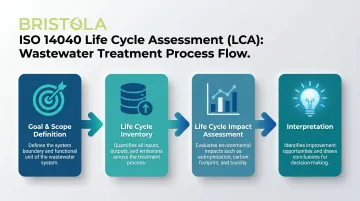
ISO 14040 structures every credible LCA into four sequential phases. Shortcuts in any phase undermine the entire analysis — which matters when LCA results are being used to justify capital investments or report environmental performance to regulators.
Phase 1 – Goal and Scope Definition
This phase answers a fundamental question before data collection begins: what is this study trying to find out, and for whom?
A wastewater LCA goal might be: "Which treatment technology produces lower climate change impact per cubic meter treated at this specific facility, given our local grid mix and sludge management options?" That question defines what gets included and what gets left out.
The functional unit is the critical decision here. Most wastewater LCAs use treatment of 1 m³ of wastewater to a defined effluent quality standard. Choosing this carefully determines whether technology comparisons will be valid — comparing systems that treat different influent concentrations or meet different discharge standards produces misleading results.
This phase also defines system boundaries. The scope decision typically comes down to:
- Narrow boundaries: operational inputs only — faster to study, but less complete
- Broad boundaries: infrastructure construction, chemical manufacturing, and sludge transport included — more resource-intensive, but fewer blind spots
Phase 2 – Life Cycle Inventory (LCI)
With scope defined, LCI is where data collection begins. Every energy input, chemical used, water volume processed, and emission to air, water, or soil gets quantified for every process inside the system boundary.
The most common gaps in wastewater LCA inventories are direct methane and nitrous oxide emissions — frequently underestimated or omitted entirely. These require site-specific measurement rather than default emission factors, yet many studies rely on generic values that don't reflect actual process conditions. Tools like SimaPro and OpenLCA structure this data collection and maintain traceability.
Phase 3 – Life Cycle Impact Assessment (LCIA)
With inventory data in hand, LCIA translates it into environmental impact scores using characterization factors (conversion multipliers that link emissions to specific impact categories). Widely used methods in wastewater LCA include ReCiPe and CML (common in European studies) and TRACI (better suited to North American contexts). Method choice affects results, which is why sensitivity analysis across methods is good practice.
This phase often produces counterintuitive findings. Indirect CO₂ from electricity consumption frequently outweighs direct process emissions in aerobic treatment systems. Meanwhile, anaerobic systems that capture and use biogas can offset a meaningful share of their operational impacts — shifting the balance in their favor on climate change metrics.
Phase 4 – Interpretation
Interpretation identifies dominant contributors (hotspots), tests sensitivity to key assumptions, and translates findings into actionable recommendations. This is where LCA value is either realized or lost.
Good interpretation connects directly back to the original goal, acknowledges uncertainty in the data, and produces clear conclusions that engineers and operators can act on. Poor interpretation produces academic summaries that inform nothing. The electricity grid mix assumption, sludge disposal route, and direct GHG emission factors should always be tested in sensitivity analysis — small changes in these inputs can reverse technology rankings entirely.
Comparing Wastewater Treatment Technologies Through LCA
No single technology is universally "best" across all impact categories. The right choice depends on local energy sources, available sludge management routes, treatment targets, and operational context. LCA makes those tradeoffs explicit rather than assumed.
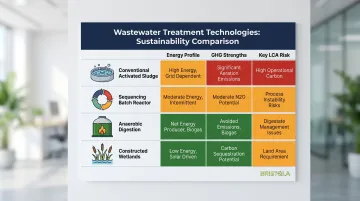
Four technologies dominate LCA comparisons in wastewater treatment: conventional activated sludge, sequencing batch reactors, anaerobic digestion, and constructed wetlands. Each carries a distinct environmental profile.
Conventional Activated Sludge (CAS)
The dominant environmental hotspot in CAS systems is aeration energy. Research on Greek activated-sludge plants found aeration accounts for approximately 67% of total plant electricity consumption, with typical energy intensity ranging from 0.30 to 0.65 kWh/m³ (though site-specific ranges extend from 0.128 to 2.280 kWh/m³ depending on plant scale and configuration).
This makes the carbon intensity of the local electricity grid one of the most influential variables in any CAS LCA. A plant running on coal-heavy grid power will show dramatically worse climate change scores than an identical plant using renewable electricity — even with identical treatment performance.
Sequencing Batch Reactor (SBR)
SBR systems offer operational flexibility and can achieve strong nutrient removal, but their aeration cycles tend to produce higher climate change impacts than simpler process configurations. A 2025 LCA case study from Vietnam found that an Anoxic-Oxic (OA) system showed approximately 30% lower climate change impact per m³ treated compared to SBR — 0.61 vs. 0.87 kg CO₂e per m³. The SBR system did outperform OA on freshwater eutrophication, a reminder that selecting a technology on a single metric will miss important environmental costs elsewhere.
Anaerobic Digestion (AD)
AD systems carry a more favorable LCA profile when biogas is captured and used for energy. Net energy recovery offsets a significant portion of operational emissions, and biosolids from AD used as agricultural fertilizer further reduce both eutrophication and climate change scores compared to landfill disposal.
Digester maintenance is directly tied to these LCA benefits. When sediment accumulation reduces active volume and impairs microbial efficiency, biogas yield drops — and so does the energy offset that makes AD's LCA profile attractive.
Constructed Wetlands and Nature-Based Solutions
Constructed wetlands score well on energy use and chemical inputs but carry higher land-use burdens and lower treatment reliability at scale. Direct CH₄ and N₂O emissions from wetland systems are also significant, particularly in systems with high organic loading. These systems perform best in LCA terms for polishing applications or rural settings where land availability isn't a constraint.
Technology Comparison Summary
| Technology | Energy Profile | GHG Strengths | Key LCA Risk |
|---|---|---|---|
| Conventional Activated Sludge | High (0.30–0.65 kWh/m³) | None without RE | Grid electricity carbon intensity |
| Sequencing Batch Reactor | High | Lower eutrophication | Aeration cycles; climate impact |
| Anaerobic Digestion | Net-positive with biogas | Biogas offsets cut net GHG significantly | Requires maintained digester performance |
| Constructed Wetlands | Low operational | Land use | CH₄/N₂O; treatment reliability |
Key Environmental Hotspots in Wastewater Treatment LCA
Energy Consumption
Electricity for aeration, pumping, and processing is the single largest contributor to climate change impacts in aerobic treatment systems. Switching to renewable energy sources or recovering biogas for on-site power generation can shift LCA outcomes substantially — in some cases moving a facility from a net emitter to near carbon-neutral on an operational basis.
The practical levers operators have here include:
- Dissolved oxygen (DO) control — reduces unnecessary aeration energy
- Blower efficiency upgrades — direct reductions in electricity draw
- Biogas-to-energy systems — displace purchased electricity and cut grid dependence
Each of these changes produces documented reductions in LCA climate change category scores.
Sludge Management Strategy
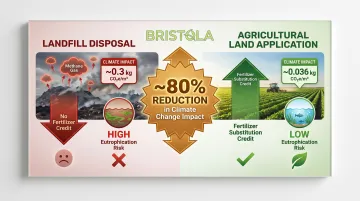
Sludge disposal route is the highest-leverage variable in wastewater LCA after energy. The same Vietnam industrial-zone study referenced above found that switching biosolids from landfill disposal to agricultural application reduced climate change impact from approximately 0.3 kg CO₂e/m³ to 0.036 kg CO₂e/m³ — roughly an 80% reduction — while also substantially reducing eutrophication impacts.
Landfilling biosolids creates ongoing methane generation and loses the fertilizer substitution credit that land application provides. Beneficial biosolids reuse is one of the most cost-effective ways to improve a facility's LCA profile — where regulations and agronomic conditions allow.
Direct GHG Emissions from Treatment Processes
Methane and nitrous oxide emitted during biological treatment are potent greenhouse gases that remain chronically underaccounted in facility-level reporting. A study across 183 Italian municipal wastewater treatment plants found that N₂O contributed 30–33% and CH₄ contributed 20–29% of total CO₂e — combined, these direct process emissions represented over 50% of plant-wide carbon footprints.
N₂O is generated during nitrification and denitrification; CH₄ escapes from anaerobic zones and uncovered treatment steps. Both have high global warming potentials (N₂O = 273, CH₄ = 27.2 on a 100-year basis per IPCC AR6), meaning even small uncontrolled release rates carry significant climate impact. For facilities running anaerobic digesters or covered lagoons, continuous emissions monitoring is the first step toward bringing these numbers under control.
How Bristola's Robotic Cleaning Technology Improves Your Facility's LCA Outcomes
The connection between tank cleanliness and LCA performance is direct and quantifiable. Sediment accumulation at the bottom of anaerobic digesters reduces the active volume available for microbial digestion, impairs heat transfer, and interferes with mixing efficiency. The result: biogas yield drops, energy input requirements increase, and the energy recovery credit that gives AD its favorable LCA profile begins to erode.
One documented case illustrates the scale of this problem: a facility whose digester had not been cleaned in over four years saw daily biogas production drop 20%, volatile solids reduction fall below 25%, and the inability to maintain required mesophilic temperatures — all LCA-relevant performance failures.
Bristola's patented zero-human-entry robotic cleaning system targets each of these failure points. A submersible ROV deploys through a patented equalization chamber entry system, cleaning anaerobic digesters, covered lagoons, and liquid storage tanks while the facility remains fully operational. No draining. No production halt. No transient period while biological processes re-establish stability.
This operational continuity matters for LCA in several ways:
- Sustained biogas yield maintains the energy recovery offset that improves climate change scores
- No restart emissions penalty — recommissioning a digester after a full shutdown involves a transient period of poor performance and elevated emissions
- Avoided downtime losses — traditional cleaning methods can cost $200,000 in lost revenue per cleaning event alone; continuous operation preserves both economic and environmental performance
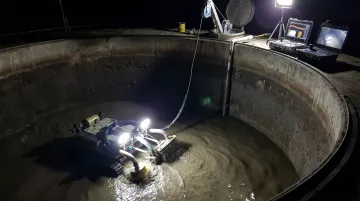
Beyond operational benefits, Bristola's integrated data reporting system captures facility condition and performance data — including sediment volumes via sonar-based mapping — that feeds directly into the LCI phase of an LCA study. Accurate inventory data is the foundation of a credible LCA, and Bristola's performance records provide the facility-specific inputs that generic emission factors can't provide.
The system also fits existing infrastructure. Any digester with a manhole 24 inches or greater in diameter can be retrofitted without major structural modification — no purpose-built access points required.
Conclusion
LCA offers something single-metric comparisons can't: a full-system view of where environmental burden actually accumulates. Energy consumption, sludge disposal, and direct GHG emissions each carry weight that only shows up when you account for the entire treatment process — not just what's visible at the point of operation.
LCA results aren't static. As grid electricity decarbonizes, sludge strategies evolve, and regulations tighten, a facility's environmental profile shifts. Periodic reassessment matters, and so does continuous operational efficiency.
Digester and tank performance directly influence the numbers that show up in an LCA. Sediment accumulation, reduced biogas yield, and increased energy draw all register as quantifiable environmental costs. Keeping systems clean and operating at capacity isn't just a maintenance concern — it's one of the more controllable variables in a facility's long-term LCA outcome.
Frequently Asked Questions
What is the life cycle assessment for wastewater treatment?
LCA for wastewater treatment is a systematic methodology standardized under ISO 14040/14044 that quantifies environmental impacts (energy use, GHG emissions, eutrophication, toxicity) across a system's full life — from construction through operation and end-of-life — giving the complete picture that operational metrics alone can't provide.
What are the 4 phases of life cycle assessment?
All four phases are required under ISO 14040:
- Goal and Scope Definition — establishes study boundaries and objectives
- Life Cycle Inventory (LCI) — collects all input/output data
- Life Cycle Impact Assessment (LCIA) — translates inventory data into impact scores
- Interpretation — identifies hotspots and produces recommendations
Which wastewater treatment technology has the best environmental LCA performance?
No single technology is universally best ; performance depends on local electricity mix, sludge management routes, and treatment targets. That said, anaerobic digestion with biogas recovery and beneficial biosolids reuse consistently scores well across multiple impact categories, particularly when digester performance is well maintained.
How does energy consumption affect the LCA of a wastewater treatment plant?
Electricity for aeration and pumping is typically the dominant contributor to climate change impacts in aerobic systems. The carbon intensity of the local grid is therefore one of the most influential variables in any wastewater LCA ; switching to renewable energy or recovering biogas for on-site power can substantially shift a facility's climate change score.
What role does sludge management play in wastewater treatment LCA?
Sludge disposal route is a key factor. Landfilling carries significant GHG and eutrophication penalties. Using biosolids as agricultural fertilizer or co-digestion feedstock can reduce climate change impacts by approximately 80% compared to landfill, while also generating fertilizer substitution credits that improve a facility's overall LCA profile.
Can anaerobic digestion improve a facility's LCA profile?
Yes. Anaerobic digestion with biogas capture and energy recovery can significantly offset operational emissions, often giving AD the most favorable LCA profile among conventional treatment options. Keeping digesters clean is essential to sustaining that advantage, since sediment accumulation reduces biogas yield and erodes the energy recovery credit.