The appeal of cleaning without draining is real: you preserve stored water, avoid logistics headaches, and keep systems running. But effectiveness depends heavily on tank size, contamination type, access configuration, and the tools used. A method that works well for a 500-gallon rainwater tank can be completely insufficient for a large industrial digester.
This guide covers the exact steps for residential and small commercial tanks, the variables that affect results, and — critically — when DIY approaches stop being appropriate and professional or robotic systems become necessary.
TL;DR
- Cleaning without draining combines surface skimming, bottom sludge extraction, surface wiping, and disinfection
- Works best for light-to-moderate buildup where water is still usable and the tank is structurally sound
- Required equipment: access hatch, sludge pump or wet vacuum, approved disinfectant, ability to shut off circulation
- Most common failures: skipping pre-cleaning inspection, stirring sediment during extraction, using wrong chemicals
- DIY methods are insufficient and potentially dangerous for large industrial tanks (digesters, wastewater, oil and gas, food processing)
- Robotic cleaning systems are the standard for industrial-scale tanks, eliminating both safety risk and operational downtime
Step-by-Step: How to Clean a Water Tank Without Emptying It
Step 1: Shut Down Circulation and Assess Tank Condition
Turn off all pumps and close inlet valves before touching anything else. Water needs to settle — disturbance during cleaning stirs sediment and undermines the entire process.
Use your inspection hatch or access port to assess:
- Sediment depth and color
- Water clarity and odor
- Visible algae growth or floating debris
- Any signs of animal contamination or heavy discoloration
Important: Do not enter the tank. Every step in this guide is designed to be performed externally. Tank entry is a confined space activity requiring atmospheric testing, written permits, a standby attendant, and specialized training — none of which should be improvised.
If your inspection reveals strong persistent odors, visible animal waste, heavy chemical discoloration, or several inches of sludge that your equipment can't reach, stop here. That tank needs a full drain and professional clean.
Step 2: Remove Surface Debris
Before any scrubbing or suction, use a skimmer net to clear the water surface. Remove floating leaves, insects, organic matter, and scum film.
Skipping this step forces more work in Step 3. Surface material that sinks during cleaning adds directly to bottom sludge. Two minutes of skimming now saves considerably more time later.
Step 3: Extract Bottom Sludge and Sediment
Lower a submersible sludge pump or wet vacuum hose slowly to the tank floor. The key word is slowly. Dropping equipment too quickly creates turbulence that redistributes fine particles throughout the water column — you'll end up with cloudier water than you started with and a long settling period before the tank is usable again.
Work methodically, section by section:
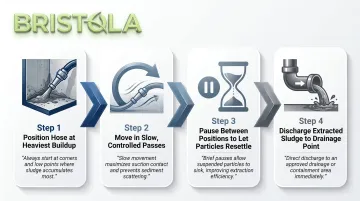
- Position the hose at the heaviest buildup area — usually corners or the center floor
- Move in slow, controlled passes — don't sweep aggressively
- Pause between positions to let disturbed particles resettle
- Discharge extracted sludge to an appropriate drainage point away from potable supply
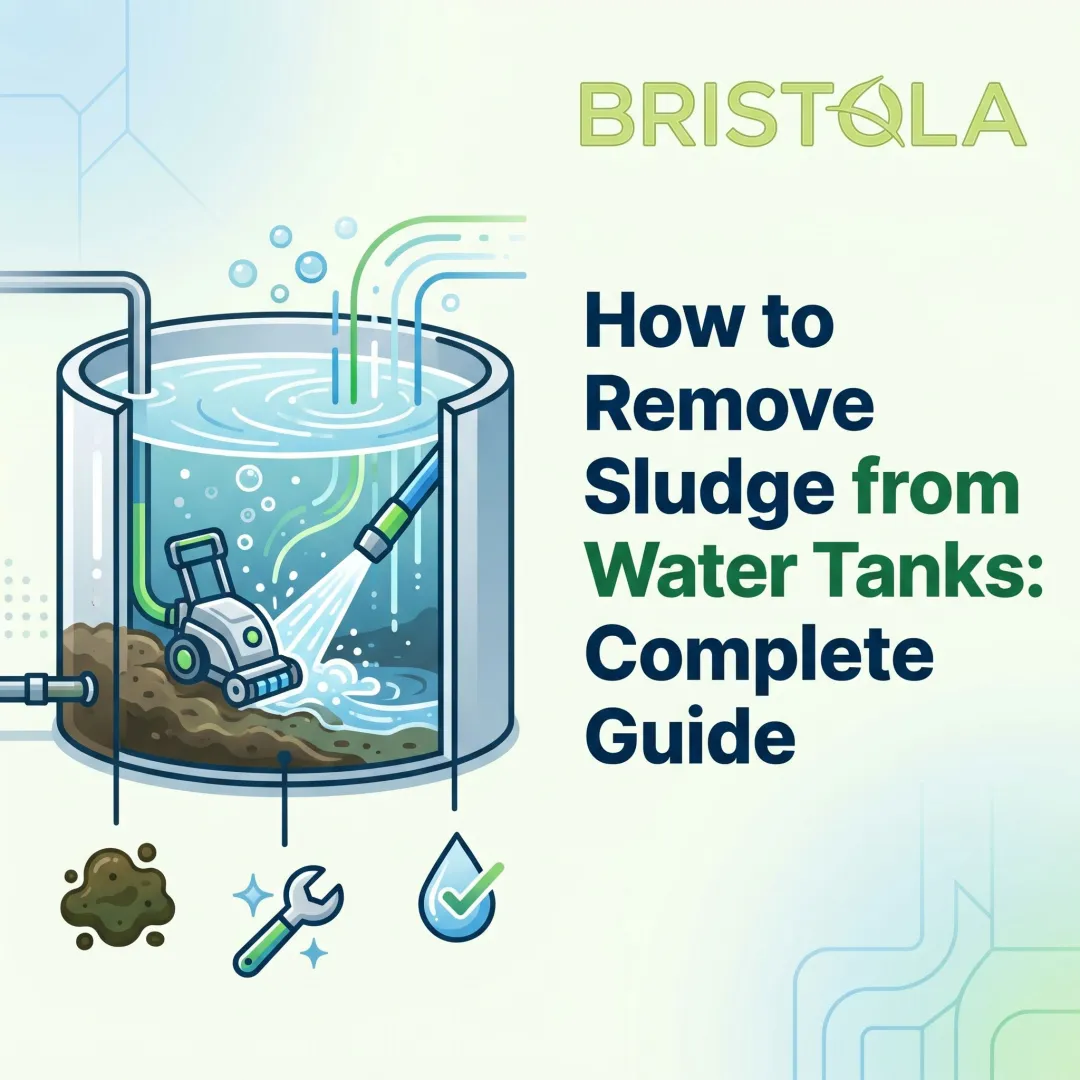
For large industrial tanks, the volume discharged during sludge extraction adds up fast. Specialized robotic cleaning systems — like those used at wastewater treatment and industrial storage facilities — filter and return cleaner water to the tank during extraction, preserving stored volume rather than draining it.
Step 4: Clean Accessible Internal Surfaces
If interior walls are reachable from the access hatch without entry, wipe down surfaces with a long-handled scrubber or damp cloth. Target algae film and mineral deposits along the waterline.
While you have access, remove and inspect:
- Inlet screens and strainers
- Mesh filters near access points
- Any visible debris caught in fittings
Replace any components showing visible degradation — a cracked screen lets debris bypass filtration and undoes your cleaning work immediately.
Step 5: Disinfect and Restore Water Quality
For potable water tanks, use low-dose chlorine or food-grade hydrogen peroxide at approved concentrations. The EPA sets the Maximum Residual Disinfectant Level for chlorine at 4.0 mg/L for finished water — but treatment-level dosing per AWWA C652 ranges from 50 to 200 mg/L, requiring mandatory dechlorination before returning the tank to service.
Hydrogen peroxide certified under NSF/ANSI Standard 60 is approved for drinking water treatment at a maximum use level of 60 mg/L.
For industrial tanks, refer to the safety data sheet for the fluid being stored. Do not apply potable-water disinfectants to tanks storing chemicals, hydrocarbons, or biological process fluids.
Once disinfection is complete:
- Allow sediment to resettle for several hours
- Flush initial water through a non-critical outlet before returning flow to primary use
- Top off with fresh water if significant volume was removed during sludge extraction
- Restart pumps only after the settling and flushing steps are complete
Key Variables That Affect Cleaning Results
The same five-step process can produce very different results depending on conditions in and around the tank. Understanding these variables helps set realistic expectations before you start.
Sediment Type and Depth
Organic sludge from leaves or biological decay is generally easier to extract than mineral scale or chemical deposits. Light sediment lifts cleanly with a wet vacuum. Heavy accumulation — several inches or more — may exceed what consumer-grade equipment can handle without multiple passes or professional-grade suction pressure.
Sediment particle density in drinking water tanks averages around 1.99 g/cm³ — lower than the 2.65 g/cm³ used in standard resuspension models. That lower density means fine particles stay suspended longer once disturbed. Move too fast, and you'll redistribute sediment rather than remove it.
Tank Size and Access Configuration
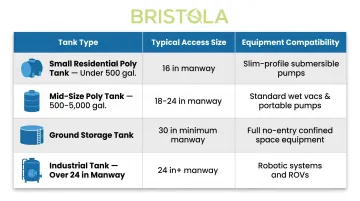
Larger tanks with limited access points restrict how thoroughly internal surfaces can be cleaned without entry. Access port size directly determines what equipment fits:
| Tank Type | Typical Access Size | Equipment Compatibility |
|---|---|---|
| Small residential poly tank (<500 gal) | 16 inches | Slim-profile pumps, narrow hose vacuums |
| Mid-size poly tank (500–5,000 gal) | 18–24 inches | Most submersible pumps, standard wet vacs |
| Ground storage tank (public water system) | 30 inches minimum (TCEQ/AWWA standard) | Full no-entry cleaning equipment |
| Industrial tank (>24 inch manway) | 24 inches+ | Robotic systems, ROVs, professional suction rigs |
Contamination Source
A rooftop rainwater tank in a vegetated area accumulates organic debris much faster than a sealed industrial tank. The contamination source determines both cleaning frequency and the right disinfection method:
- Tanks exposed to rooftop runoff may need partial cleaning every 3–4 months during high-organic seasons
- Sealed, climate-controlled tanks typically extend longer between full cleanouts
Chemical Selection and Dosage
Using the wrong cleaner — or overdosing — can corrode internal surfaces, damage downstream systems, or leave harmful residues in potable supply.
| Tank Type | Appropriate Disinfectant | What to Avoid |
|---|---|---|
| Potable water | Low-dose chlorine (≤4 mg/L residual), NSF/ANSI 60-certified H₂O₂ | Scented bleach, color-safe bleach, undiluted concentrations |
| Rainwater (non-potable) | Unscented chlorine bleach at approved dilution | Household cleaners, industrial solvents |
| Anaerobic digester | Consult process engineer — wrong chemicals destroy beneficial microbial populations | Any standard disinfectant not cleared for biological process systems |
| Oil/chemical storage | Refer to SDS for stored fluid | Any water-treatment chemical |
Common Mistakes When Cleaning a Tank Without Draining It
Most errors in no-drain tank cleaning come down to skipping steps, rushing equipment, or using the wrong chemical. Here are the three that cause the most damage.
Skipping the pre-cleaning inspection. Entering a cleaning procedure without assessing sediment levels, water clarity, or odor leads to using the wrong method — or missing contamination that actually requires full drainage. Trigger a full drain instead if you notice:
- Strong or persistent odor
- Visible animal contamination
- Heavy discoloration that doesn't clear
- Sediment your equipment physically can't remove
Stirring sediment during extraction. Dropping a vacuum hose too quickly or working too aggressively redistributes fine particles throughout the water column. Lower the hose slowly, work in controlled sections, pause between positions, and never sweep or drag the hose across the tank floor at speed.
Using household cleaners or undiluted bleach. These leave chemical residues dangerous to humans, animals, and — in biogas digesters — the beneficial microbial populations essential to biogas production. The EPA cautions against scented bleach, color-safe bleach, and products with added cleaners. Use only regular unscented chlorine bleach at approved dilutions, or NSF/ANSI 60-certified products for potable applications. Industrial solvent-based cleaners should never enter potable or biological process tanks.
When DIY Methods Aren't Enough: Cleaning Large Industrial Liquid Storage Tanks
The methods above work well for residential rainwater tanks, agricultural water storage, and small commercial applications. They become insufficient, and potentially dangerous, when applied to large industrial liquid storage facilities.
Think anaerobic digesters, covered biogas lagoons, wastewater treatment tanks, oil and gas storage, food processing vessels, and pulp and paper production tanks. The scale and hazard profile of these facilities is categorically different.
The Cost of Traditional Industrial Tank Cleaning
Conventional drain-and-clean for a large digester typically requires:
- 7 to 14 days offline for a 1,000 m³ tank
- 24 to 72 hours of ventilation and gas testing before any crew entry
- $20,000 to over $100,000 in direct cleaning costs
- $2,400 to $4,800 per day in lost revenue for a 1 MW biogas plant
- Several weeks to months of biological recommissioning afterward
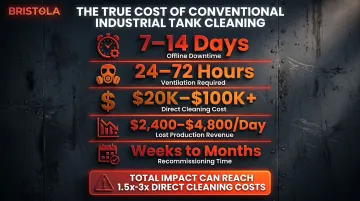
The total financial impact (direct costs, mobilization, disposal, and lost production) can reach 1.5x to 3x the direct cleaning expense. For facilities cleaning annually, those losses compound fast.
Sediment buildup itself degrades performance well before a cleanout is scheduled. One documented case involving an EnviTec digester showed a 20% drop in daily biogas production and volatile solids reduction falling below 25% after four years without cleaning. The Water Environment Federation confirms that accumulated grit and inert solids reduce effective digestion volume, hindering gas production and increasing cleaning frequency over time.
The Safety Dimension Nobody Ignores Twice
According to BLS data covering 2011 to 2018, 1,030 workers died from injuries involving confined spaces, with storage tanks accounting for approximately 23% of those fatalities — the single largest category. That's an average of roughly 129 deaths per year, in an environment that industrial operators enter routinely for maintenance.
OSHA's 29 CFR 1910.146 imposes extensive requirements for every permit-required confined space entry: atmospheric testing for oxygen levels between 19.5% and 23.5%, testing for flammable and toxic gases, a written entry permit, a standby attendant for the entire duration, and documented rescue procedures. Water tanks are explicitly covered.
That regulatory burden doesn't make confined space entry safer — it makes the paperwork manageable while the physical risk remains.
How Bristola Solves Both Problems
Bristola was founded specifically because of what confined space entry does to people. Founder Jared Burma's near-death experience inside a tank in 2019 drove the development of a system designed around one principle: no human should ever need to enter a tank to clean it.
Bristola's patented robotic cleaning system deploys a remote-controlled submersible ROV through a proprietary equalization chamber entry system — an airlock-type portal installed on the tank's manhole (compatible with any opening 24 inches in diameter or greater). The robot enters through the roof or lagoon cover, cleans the floor and walls, and is retrieved through the same portal.
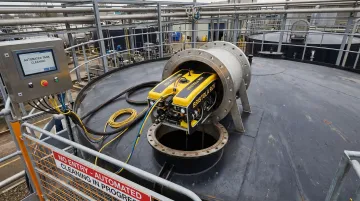
No crew enters the tank. No tank is drained.
The operational requirement is actually the reverse of traditional methods: Bristola requires the tank to remain in production during cleaning, because the stored liquid dilutes sediment for extraction. The tank doesn't pause. It keeps producing.
The system serves more than a dozen industrial verticals — anaerobic digesters, wastewater treatment, oil and gas, food processing, pulp and paper, steel mills, and others — across the US, Canada, Europe, the Middle East, Australia, and India.
Bristola's comparative cost analysis puts the annualized cost of traditional cleaning at $250,000 per tank, versus $170,000 using their robotic system — a savings of $80,000 per tank per year, primarily by eliminating the $200,000 in revenue lost during operational downtime.
For facilities running annual cleanouts, that $80,000 annual gap is the starting point — not the ceiling. Eliminating confined space entry removes mobilization costs, regulatory compliance overhead, and recommissioning delays that traditional cleaning routinely accumulates on top.
Frequently Asked Questions
Can you clean a water tank without emptying it?
Yes. Using sludge vacuuming, surface skimming, accessible surface wiping, and appropriate disinfection, most residential and small commercial tanks can be cleaned without draining. Effectiveness depends on contamination level and tank size — heavily contaminated or large industrial tanks require specialized equipment or professional service.
How often should you clean a water tank without draining it?
Partial maintenance cleaning is recommended every 6 to 12 months for residential tanks, with a full professional clean every 2 to 5 years. The CDC recommends annual inspection for elevated tanks in healthcare settings. Industrial tanks should follow a schedule tied to operational load and performance data.
What is the best way to remove sludge from the bottom of a water tank without emptying it?
A submersible sludge pump or wet vacuum hose lowered slowly to the tank floor is the most effective method. Work in controlled sections and move the hose gently — aggressive technique stirs fine particles into the water column and requires long settling periods before the water is usable again.
What chemicals are safe to use when cleaning a water tank without removing the water?
For potable water tanks, low-dose unscented chlorine or NSF/ANSI 60-certified hydrogen peroxide (at or below 60 mg/L) are appropriate. Scented bleach, color-safe bleach, undiluted concentrations, and household cleaners should never be used — they contaminate the supply or degrade tank materials.
When should you fully drain a water tank instead of cleaning it in place?
Full drainage is necessary when there is animal or chemical contamination, a persistent odor, sludge beyond what suction equipment can remove, or visible structural damage. In these cases, partial cleaning is insufficient and can create a false sense that the problem has been resolved.
Is it safe to enter a water tank to clean it?
No — not without proper preparation. Tank entry is a confined space activity under OSHA 1910.146, requiring atmospheric testing, a written entry permit, a standby attendant, and documented rescue procedures. Untrained individuals should never enter a tank — all methods in this guide are performed externally, from outside the tank.